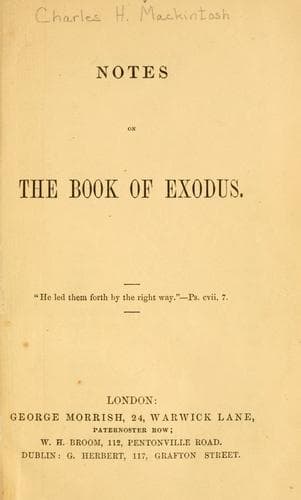
Notes on the book of ExodusMackintosh, Charles Henry
Religion
Notes on the book of Exodus
Mackintosh, Charles Henry
Bible. Exodus -- Commentaries
"What shall we say then? Is the law sin? God forbid. Nay, I had not
known sin, but by the law; for I had not known lust, except the law
had said, 'Thou shalt not covet.'" (Rom. vii. 7.) He does not say that
he would not have had "lust." No; but merely that he "had not known"
it. The "lust" was there; but he was in the dark about it until the
law, as "the candle of the Almighty," shone in upon the dark chambers
of his heart and revealed the evil that was there. Like a man in a
dark room, who may be surrounded with dust and confusion, but he
cannot see aught thereof by reason of the darkness. Let the beams of
the sun dart in upon him, and he quickly perceives all. Do the
sunbeams create the dust? Surely not. The dust is there, and they only
detect and reveal it. This is a simple illustration of the effect of
the law. It judges man's character and condition; it proves him to be
a sinner, and shuts him up under the curse; it comes to judge what he
is, and curses him if he is not what it tells him he ought to be.
It is therefore a manifest impossibility that any one can get life and
righteousness by that which can only curse him; and unless the
condition of the sinner, and the character of the law are totally
changed, it can do naught else but curse him. It makes no allowance
for infirmities, and knows nothing of sincere, though imperfect,
obedience. Were it to do so, it would not be what it is--"holy, just,
and good." It is just because the law is what it is that the sinner
cannot get life by it. If he could get life by it, it would not be
perfect, or else he would not be a sinner. It is impossible that a
sinner can get life by a perfect law, for inasmuch as it is perfect,
it must needs condemn him. Its absolute perfectness makes manifest and
seals man's absolute ruin and condemnation. "Therefore, by deeds of
law shall no flesh living be justified in His sight; for by the law is
the knowledge of sin." (Rom. iii. 20.) He does not say, By the law is
sin, but only "the knowledge of sin." "For until the law, sin was in
the world; but sin is not imputed when there is no law." (Rom. v. 13.)
Sin was there, and it only needed law to develop it in the form of
"transgression." It is as if I say to my child, You must not touch
that knife. My very prohibition reveals the tendency in his heart to
do his own will. It does not create the tendency, but only reveals it.
Public-domain text, read in full here on John Shaqi.
Reviews
Reviews
No reviews yet
Be the first to share your thoughts on this work.
Elsewhere in the archive
Join the Discussion
Join the discussion
Sign in to leave a comment or review.
Sign InorCreate an account