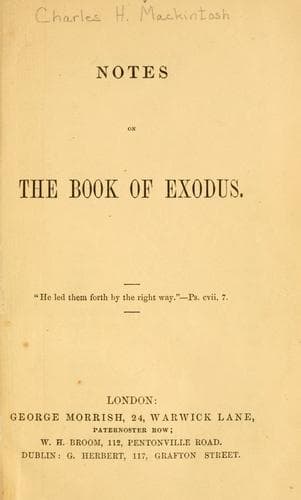
Notes on the book of ExodusMackintosh, Charles Henry
Religion
Notes on the book of Exodus
Mackintosh, Charles Henry
Bible. Exodus -- Commentaries
The apostle John says that "sin is lawlessness." (1 John iii. 4.) The
word "transgression" does not develop the true idea of the Spirit in
this passage. In order to have "transgression," I must have a definite
rule or line laid down. Transgression means a passing across a
prohibited line; such a line I have in the law. I take any one of its
prohibitions, such as, "Thou shalt not kill," "Thou shalt not commit
adultery," "Thou shalt not steal." Here I have a rule or line set
before me; but I find I have within me the very principles against
which these prohibitions are expressly directed. Yea, the very fact of
my being told not to commit murder shows that I have murder in my
nature. There would be no necessity to tell me not to do a thing
which I had no tendency to do; but the exhibition of God's will as to
what I ought to be makes manifest the tendency of my will to be what I
ought not. This is plain enough, and is in full keeping with the whole
of the apostolic reasoning on the point.
Many, however, will admit that we cannot get life by the law; but they
maintain, at the same time, that the law is our rule of life. Now, the
apostle declares that "as many as are of works of law are under the
curse." (Gal. iii. 10.) It matters not who they are, if they occupy
the ground of law, they are, of necessity, under the curse. A man may
say, I am regenerate, and therefore not exposed to the curse. This
will not do. If regeneration does not take one off the ground of law,
it cannot take him beyond the range of the curse of the law. If the
Christian be under the former, he is, of necessity, exposed to the
latter. But what has the law to do with regeneration? where do we find
any thing about it in Exodus xx? The law has but one question to put
to a man,--a brief, solemn, pointed question, namely, Are you what you
ought to be? If he answer in the negative, it can but hurl its
terrible anathema at him and slay him. And who will so readily and
emphatically admit that, in himself, he is any thing but what he ought
to be, as the really regenerate man? Wherefore, if he is under the
law, he must inevitably be under the curse. The law cannot possibly
lower its standard, nor yet amalgamate with grace. Men do constantly
seek to lower its standard; they feel that they cannot get up to it,
and they therefore seek to bring it down to them; but the effort is in
vain: it stands forth in all its purity, majesty, and stern
inflexibility, and will not accept a single hair's breadth short of
perfect obedience; and where is the man, regenerate or unregenerate,
that can undertake to produce that? It will be said, We have
perfection in Christ. True; but that is not by the law, but by grace;
and we cannot possibly confound the two economies. Scripture largely
and distinctly teaches that we are not justified by the law; nor is
the law our rule of life. That which can only curse can never justify,
and that which can only kill can never be a rule of life. As well
Public-domain text, read in full here on John Shaqi.
Reviews
Reviews
No reviews yet
Be the first to share your thoughts on this work.
Elsewhere in the archive
Join the Discussion
Join the discussion
Sign in to leave a comment or review.
Sign InorCreate an account