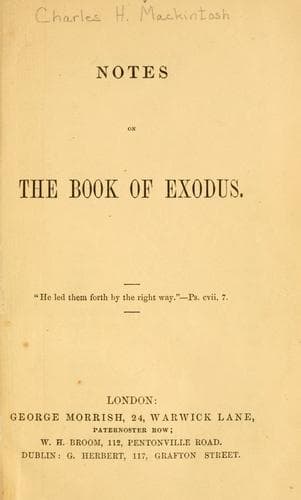
Notes on the book of ExodusMackintosh, Charles Henry
Religion
Notes on the book of Exodus
Mackintosh, Charles Henry
Bible. Exodus -- Commentaries
might a man attempt to make a fortune by a deed of bankruptcy filed
against him.
If my reader will turn to the fifteenth of Acts, he will see how the
attempt to put Gentile believers under the law as a rule of life was
met by the Holy Ghost. "There rose up certain of the sect of the
Pharisees which believed, saying, that it was needful to circumcise
them, and to command them to keep the law of Moses." This was nothing
else than the hiss of the old serpent, making itself heard in the dark
and depressing suggestion of those early legalists. But let us see how
it was met by the mighty energy of the Holy Ghost, and the unanimous
voice of the twelve apostles and the whole Church. "And when there had
been much disputing, Peter rose up, and said unto them, 'Men and
brethren, ye know how that a good while ago God made choice among us,
that the Gentiles by my mouth should hear'"--what? Was it the
requirements and the curses of _the law_ of Moses? No. Blessed be God,
these are not what He would have falling on the ears of helpless
sinners. Hear what, then? "SHOULD HEAR THE WORD OF THE GOSPEL, AND
BELIEVE." This was what suited the nature and character of God. He
never would have troubled men with the dismal accents of requirement
and prohibition. These Pharisees were not His messengers; far from it.
They were not the bearers of glad tidings, nor the publishers of
peace, and therefore their "feet" were aught but "beautiful" in the
eyes of One who only delights in mercy.
"Now, therefore," continues the apostle, "why tempt ye God, to put a
yoke upon the neck of the disciples, which neither our fathers nor we
were able to bear?" This was strong, earnest language. God did not
want "to put a yoke upon the neck" of those whose hearts had been set
free by the gospel of peace. He would rather exhort them to stand fast
in the liberty of Christ, and not be "entangled again with the yoke of
bondage." He would not send those whom He had received to His bosom of
love to be terrified by the "blackness and darkness and tempest" of
"the mount that might be touched." How could we ever admit the thought
that those whom God had received in grace He would rule by law?
Impossible. "We believe," says Peter, "that through the GRACE OF THE
LORD JESUS CHRIST we shall be saved, even as they." Both the Jews, who
had received the law, and the Gentiles, who never had, were now to be
"_saved_ through _grace_." And not only were they to be "saved" by
grace, but they were to "stand" in grace (Rom. v. 2.) and to "grow in
grace" (2 Pet. iii. 18.). To teach any thing else was to "tempt God."
Those Pharisees were subverting the very foundations of the Christian
faith; and so are all those who seek to put believers under the law.
There is no evil or error more abominable in the sight of the Lord
than legalism. Hearken to the strong language--the accents of
righteous indignation--which fell from the Holy Ghost in reference to
those teachers of the law,--"I would they were even cut off which
Public-domain text, read in full here on John Shaqi.
Reviews
Reviews
No reviews yet
Be the first to share your thoughts on this work.
Elsewhere in the archive
Join the Discussion
Join the discussion
Sign in to leave a comment or review.
Sign InorCreate an account