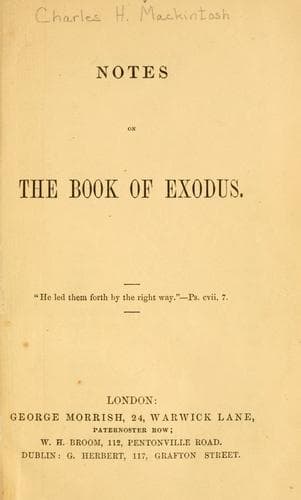
Notes on the book of ExodusMackintosh, Charles Henry
Religion
Notes on the book of Exodus
Mackintosh, Charles Henry
Bible. Exodus -- Commentaries
Such, then, is the double character of instruction to be gleaned from
the laws and ordinances in this section, looked at as a whole; and the
more minutely we look at them in detail, the more impressed we shall
be with a sense of their fullness and beauty. Take, for instance, the
very first ordinance that presents itself, namely, that of the Hebrew
servant.
"Now these are the judgments which thou shalt set before them: If thou
buy a Hebrew servant, six years he shall serve, and in the seventh he
shall go out free for nothing. If he came in by himself, he shall go
out by himself: if he were married, then his wife shall go out with
him. If his master have given him a wife, and she have borne him sons
or daughters, the wife and her children shall be her master's, and he
shall go out by himself. And if the servant shall plainly say, I love
my master, my wife, and my children; I will not go out free; then his
master shall bring him unto the judges: he shall also bring him to the
door, or unto the door-post; and his master shall bore his ear through
with an awl; and he shall serve him forever." (Chap. xxi. 1-6.) The
servant was perfectly free to go out, so far as he was personally
concerned. He had discharged every claim, and could therefore walk
abroad in unquestioned freedom; but because of his love to his master,
his wife, and his children, he voluntarily bound himself to perpetual
servitude; and not only so, but he was also willing to bear, in his
own person, the marks of that servitude.
Public-domain text, read in full here on John Shaqi.
Reviews
Reviews
No reviews yet
Be the first to share your thoughts on this work.
Elsewhere in the archive
Join the Discussion
Join the discussion
Sign in to leave a comment or review.
Sign InorCreate an account