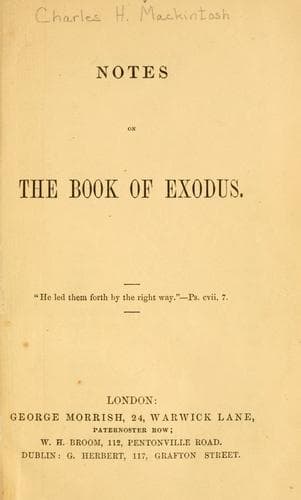
Notes on the book of ExodusMackintosh, Charles Henry
Religion
Notes on the book of Exodus
Mackintosh, Charles Henry
Bible. Exodus -- Commentaries
The application of this to the Lord Jesus Christ will be obvious to
the intelligent reader. In Him we behold the One who dwelt in the
bosom of the Father before all worlds--the object of His eternal
delight--who might have occupied, throughout eternity, this His
personal and entirely peculiar place, inasmuch as there lay upon Him
no obligation (save that which ineffable love created and ineffable
love incurred) to abandon that place. Such, however, was His love to
the Father, whose counsels were involved, and for the Church
collectively and each individual member thereof, whose salvation was
involved, that He voluntarily came down to earth, emptied Himself, and
made Himself of no reputation, took upon Him the form of a servant and
the marks of perpetual service. To these marks we probably have a
striking allusion in the Psalms.--"Mine ears hast Thou digged." (Ps.
xl. 6, marg.) This psalm is the expression of Christ's devotedness to
God. "Then said I, 'Lo, I come: in the volume of the book it is
written of Me, I delight to do Thy will, O My God; yea, Thy law is
within My heart.'" He came to do the will of God, whatever that will
might be. He never once did His own will, not even in the reception
and salvation of sinners, though surely His loving heart, with all its
affections, was most fully in that glorious work. Still He receives
and saves only as the servant of the Father's counsels. "All that the
Father giveth Me shall come to Me; and him that cometh to Me I will in
no wise cast out. For I came down from heaven, not to do Mine own
will, but the will of Him that sent Me. And this is the Father's will
which hath sent Me, that of all which He hath given Me I should lose
nothing, but should raise it up again at the last day." (John vi.
37-39.)
Here we have a most interesting view of the servant-character of the
Lord Jesus Christ. He, in perfect grace, holds Himself responsible to
receive all who come within the range of the divine counsels; and not
only to receive them, but to preserve them through all the
difficulties and trials of their devious path down here,--yea, in the
article of death itself, should it come, and to raise them all up in
the last day. Oh, how secure is the very feeblest member of the Church
of God! He is the subject of God's eternal counsels, which counsels
the Lord Jesus Christ is pledged to carry out. Jesus loves the Father,
and in proportion to the intensity of that love is the security of
each member of the redeemed family. The salvation of the sinner who
believes on the name of the Son of God is, in one aspect of it, but
the expression of Christ's love to the Father. If one such could
perish, through any cause whatsoever, it would argue that the Lord
Jesus Christ was unable to carry out the will of God, which were
nothing short of positive blasphemy against His sacred name, to whom
be all honor and majesty throughout the everlasting ages.
Public-domain text, read in full here on John Shaqi.
Reviews
Reviews
No reviews yet
Be the first to share your thoughts on this work.
Elsewhere in the archive
Join the Discussion
Join the discussion
Sign in to leave a comment or review.
Sign InorCreate an account