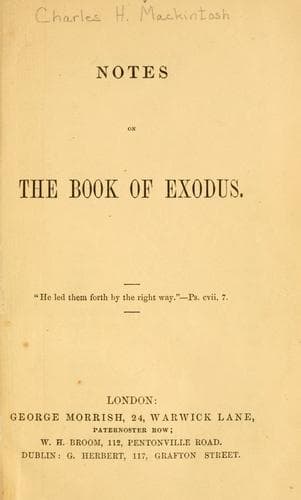
Notes on the book of ExodusMackintosh, Charles Henry
Religion
Notes on the book of Exodus
Mackintosh, Charles Henry
Bible. Exodus -- Commentaries
This chapter forms the commencement of one of the richest veins in
Inspiration's exhaustless mine--a vein in which every stroke of the
mattock brings to light untold wealth. We know the mattock with which
alone we can work in such a mine, namely, the distinct ministry of the
Holy Ghost. Nature can do nothing here. Reason is blind, imagination
utterly vain; the most gigantic intellect, instead of being able to
interpret the sacred symbols, appears like a bat in the sunshine,
blindly dashing itself against the objects which it is utterly unable
to discern. We must compel reason and imagination to stand without,
while, with a chastened heart, a single eye, and a spiritual mind, we
enter the hallowed precincts and gaze upon the deeply significant
furniture. God the Holy Ghost is the only One who can conduct us
through the courts of the Lord's house, and expound to our souls the
true meaning of all that there meets our view. To attempt the
exposition by the aid of intellect's unsanctified powers, would be
infinitely more absurd than to set about the repairs of a watch with
a blacksmith's tongs and hammer. "The pattern of things in the
heavens" cannot be interpreted by the natural mind, in its most
cultivated form. They must all be read in the light of heaven: earth
has no light which could at all develop their beauties. The One who
furnished the patterns can alone explain what the patterns mean,--the
One who furnished the beauteous symbols can alone interpret them.
To the human eye there would seem to be a desultoriness in the mode in
which the Holy Ghost has presented the furniture of the tabernacle;
but in reality, as might be expected, there is the most perfect order,
the most remarkable precision, the most studious accuracy. From
chapter xxv. to chapter xxx. inclusive, we have a distinct section of
the book of Exodus. This section is divided into two parts, the first
terminating at chapter xxvii. 19, and the second at the close of
chapter xxx. The former begins with the ark of the covenant, inside
the vail, and ends with the brazen altar and the court in which that
altar stood. That is, it gives us, in the first place, Jehovah's
throne of judgment, whereon He sat as Lord of all the earth; and it
conducts us to that place where He met the sinner, in the credit and
virtue of accomplished atonement. Then, in the latter, we have the
mode of man's approach to God--the privileges, dignities, and
responsibilities of those who, as priests, were permitted to draw nigh
to the Divine Presence and enjoy worship and communion there. Thus the
arrangement is perfect and beautiful. How could it be otherwise,
seeing that it is divine? The ark and the brazen altar present, as it
were, two extremes. The former was the throne of God established in
"justice and judgment" (Ps. lxxxix. 14.); the latter was the place of
approach for the sinner where "mercy and truth" went before Jehovah's
face. Man, in himself, dared not to approach the ark to meet God, for
Public-domain text, read in full here on John Shaqi.
Reviews
Reviews
No reviews yet
Be the first to share your thoughts on this work.
Elsewhere in the archive
Join the Discussion
Join the discussion
Sign in to leave a comment or review.
Sign InorCreate an account