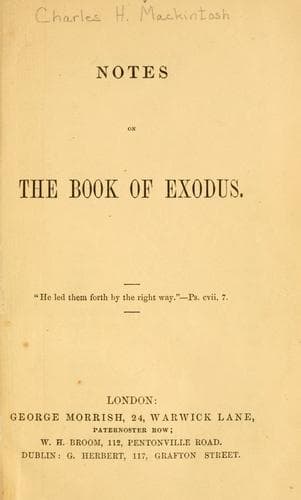
Notes on the book of ExodusMackintosh, Charles Henry
Religion
Notes on the book of Exodus
Mackintosh, Charles Henry
Bible. Exodus -- Commentaries
"the way into the holiest of all was not yet made manifest" (Heb. ix.
8.); but God could approach the altar of brass, to meet man as a
sinner. "Justice and judgment" could not admit the sinner in, but
"mercy and truth" could bring God out; not, indeed, in that
overwhelming brightness and majesty in which He was wont to shine
forth from between those mystic supporters of His throne--"the
cherubim of glory," but in that gracious ministry which is
symbolically presented to us in the furniture and ordinances of the
tabernacle.
All this may well remind us of the path trodden by that blessed One
who is the antitype of all these types--the substance of all these
shadows. He traveled from the eternal throne of God in heaven, down to
the depth's of Calvary's cross. He came from all the glory of the
former, down into all the shame of the latter, in order that He might
conduct His redeemed, forgiven, and accepted people back with Himself,
and present them faultless before that very throne which He had left
on their account. The Lord Jesus fills up, in His own Person and work,
every point between the throne of God and the dust of death, and
every point between the dust of death and the throne of God. In Him,
God has come down, in perfect grace, to the sinner; in Him, the sinner
is brought up, in perfect righteousness, to God. All the way from the
ark to the brazen altar was marked with the footprints of love, and
all the way from the brazen altar to the ark of God was sprinkled with
the blood of atonement; and as the ransomed worshiper passes along
that wondrous path, he beholds the name of Jesus stamped on all that
meets his view. May that name be dearer to our hearts! Let us now
proceed to examine the chapters consecutively.
It is most interesting to note here that the first thing which the
Lord communicates to Moses is His gracious purpose to have a
sanctuary, or holy dwelling-place, in the midst of His people--a
sanctuary composed of materials which directly point to Christ, His
Person, His work, and the precious fruit of that work, as seen in the
light, the power, and the varied graces of the Holy Ghost. Moreover,
these materials were the fragrant fruit of the grace of God--the
voluntary offerings of devoted hearts. Jehovah, whose majesty "the
heaven of heavens could not contain," was graciously pleased to dwell
in a boarded and curtained tent erected for Him by those who cherished
the fond desire to hail His presence amongst them. This tabernacle may
be viewed in two ways: first, as furnishing "a pattern of things in
the heavens," and secondly, as presenting a deeply significant type of
the body of Christ. The various materials of which the tabernacle was
composed will come before us as we pass along; we shall therefore
consider the three comprehensive subjects put before us in this
chapter, namely, the ark, the table, and the candlestick.
Public-domain text, read in full here on John Shaqi.
Reviews
Reviews
No reviews yet
Be the first to share your thoughts on this work.
Elsewhere in the archive
Join the Discussion
Join the discussion
Sign in to leave a comment or review.
Sign InorCreate an account