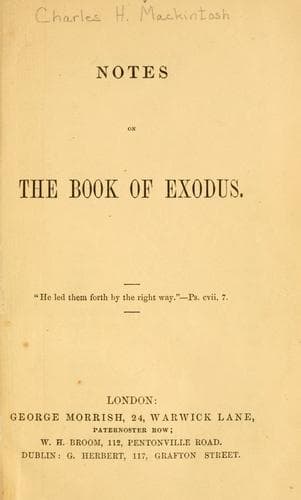
Notes on the book of ExodusMackintosh, Charles Henry
Religion
Notes on the book of Exodus
Mackintosh, Charles Henry
Bible. Exodus -- Commentaries
When we turn away our eyes from man, and fix them upon the only true
and perfect Servant, we do not find Him looking this way and that way,
for this simple reason, that He never had His eye upon men, but always
upon God. He feared not the wrath of man, nor sought his favor. He
never opened His lips to elicit human applause, nor kept them closed
to avoid human censure. This gave holy stability and elevation to all
He said and did. Of Him alone could it be truly said, "His leaf shall
not wither, and _whatsoever_ he doeth shall prosper." Everything He
did turned to profitable account, because everything was done to God.
Every action, every word, every movement, every look, every thought,
was like a beauteous cluster of fruit, sent up to refresh the heart of
God. He was never afraid of the results of His work, because He always
acted with and for God, and in the full intelligence of His mind. His
own will, though divinely perfect, never once mingled itself in aught
that He did, as a man, on the earth. He could say, "I came down from
heaven, not to do Mine own will, but the will of Him that sent Me."
Hence, He brought forth fruit "_in its season_." He did "_always_
those things which pleased the Father," and therefore never had any
occasion to "fear," to "repent," or to "look this way and that way."
Now in this, as in everything else, the blessed Master stands in
marked contrast with His most honored and eminent servants. Even a
Moses "feared," and a Paul "repented;" but the Lord Jesus never did
either. He never had to retrace a step, to recall a word, or correct a
thought. All was absolutely perfect: all was "fruit in season." The
current of His holy and heavenly life flowed onward without a ripple
and without a curve. His will was divinely subject. The best and most
devoted men make mistakes; but it is perfectly certain that the more
we are enabled, through grace, to mortify our own will, the fewer our
mistakes will be. Truly happy it is when, in the main, our path is
really a path of faith and single-eyed devotedness to Christ.
Thus it was with Moses. He was a man of faith--a man who drank deeply
into the spirit of his Master, and walked with marvelous steadiness in
His footprints. True, he anticipated, as has been remarked, by forty
years, the Lord's time of judgment on Egypt and deliverance for
Israel; yet, when we turn to the inspired commentary, in Hebrews xi,
we find nothing about this; we there find only the divine principle
upon which, in the main, his course was founded. "By faith Moses,
_when he was come to years_, refused to be called the son of
Pharaoh's daughter, choosing rather to suffer affliction with the
people of God than to enjoy the pleasures of sin for a season;
esteeming the reproach of Christ greater riches than the treasures in
Egypt; for he had respect unto the recompense of the reward. By faith
he forsook Egypt, not fearing the wrath of the king; for he endured as
seeing Him who is invisible." (Ver. 24-27.)
Public-domain text, read in full here on John Shaqi.
Reviews
Reviews
No reviews yet
Be the first to share your thoughts on this work.
Join the Discussion
Join the discussion
Sign in to leave a comment or review.
Sign InorCreate an account