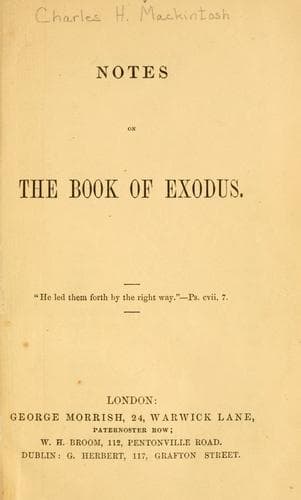
Notes on the book of ExodusMackintosh, Charles Henry
Religion
Notes on the book of Exodus
Mackintosh, Charles Henry
Bible. Exodus -- Commentaries
However, it was not always to be a traveler. "The afflictions of
David," as well as the wars of Israel, were to have an end. The prayer
was yet to be breathed and answered, "Arise, O Lord, into _Thy rest_:
Thou and _the ark of Thy strength_." (Ps. cxxxii. 8.) This most
sublime petition had its partial accomplishment in the palmy days of
Solomon, when "the priests brought in the ark of the covenant of the
Lord unto his place, into the oracle of the house, to the most holy
place, even under the wings of the cherubim. For the cherubim spread
forth their two wings over the place of the ark, and the cherubim
covered the ark and the staves thereof above. And _they drew out the
staves_, that the ends of the staves were seen out in the holy place
before the oracle, and they were not seen without: and there they are
unto this day." (1 Kings viii. 6-8.) The sand of the desert was to be
exchanged for the golden floor of the temple. (1 Kings vi. 30.) The
wanderings of the ark were to have an end: there was "neither enemy
nor evil occurrent," and therefore "the staves were drawn out."
Nor was this the only difference between the ark in the tabernacle and
in the temple. The apostle, speaking of the ark in its wilderness
habitation, describes it as "the ark of the covenant, overlaid round
about with gold, wherein was the golden pot that had manna, and
Aaron's rod that budded, and the tables of the covenant." (Heb. ix.
4.) Such were the contents of the ark in its wilderness
journeyings--the pot of manna, the record of Jehovah's faithfulness in
providing for His redeemed in the desert, and Aaron's rod, "a token
against the rebels," to "take away their murmurings." (Compare Exod.
xvi. 32-34, and Numb. xvii. 10.) But when the moment arrived in which
"the staves" were to be "drawn out," when the wanderings and wars of
Israel were over, when the "exceeding magnificial" house was
completed, when the sun of Israel's glory had reached, in type, its
meridian, as marked by the wealth and splendor of Solomon's reign,
then the records of wilderness need and wilderness failure were
unnoticed, and nothing remained save that which constituted the
eternal foundation of the throne of the God of Israel, and of all the
earth. "_There was nothing in the ark save the two tables of stone_,
which Moses put there at Horeb." (1 Kings viii. 9.)
Public-domain text, read in full here on John Shaqi.
Reviews
Reviews
No reviews yet
Be the first to share your thoughts on this work.
Elsewhere in the archive
Join the Discussion
Join the discussion
Sign in to leave a comment or review.
Sign InorCreate an account