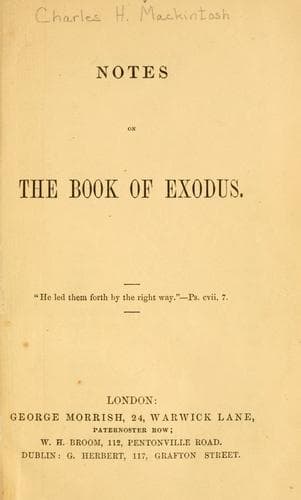
Notes on the book of ExodusMackintosh, Charles Henry
Religion
Notes on the book of Exodus
Mackintosh, Charles Henry
Bible. Exodus -- Commentaries
The ark of the covenant occupies the leading place in the divine
communications to Moses. Its position, too, in the tabernacle was most
marked. Shut in within the vail, in the holiest of all, it formed the
base of Jehovah's throne. Its very name conveys to the mind its
import. An ark, so far as the Word instructs us, is designed to
preserve _intact_ whatever is put therein. An ark carried Noah and his
family, together with all the orders of creation, in safety over the
billows of judgment which covered the earth: an ark, at the opening of
this book, was faith's vessel for preserving "a proper child" from the
waters of death. When, therefore, we read of "the ark of the
covenant," we are led to believe that it was designed of God to
preserve His covenant unbroken in the midst of an erring people. In
it, as we know, the second set of tables were deposited. As to the
first set, they were broken in pieces beneath the mount, showing that
man's covenant was wholly abolished--that his work could never, by any
possibility, form the basis of Jehovah's throne of government.
"Justice and judgment are the habitation of that throne," whether in
its earthly or heavenly aspect. The ark could not contain within its
hallowed inclosure broken tables. Man might fail to fulfill his
self-chosen vow, but God's law must be preserved in its divine
integrity and perfectness. If God was to set up His throne in the
midst of His people, He could only do so in a way worthy of Himself.
His standard of judgment and government must be perfect.
"And thou shalt make staves of shittim wood, and overlay them with
gold. And thou shalt put the staves into the rings by the sides of the
ark, that the ark may be borne with them." The ark of the covenant was
to accompany the people in all their wanderings. It never rested while
they were a traveling or a conflicting host; it moved from place to
place in the wilderness; it went before them into the midst of Jordan;
it was their grand rallying-point in all the wars of Canaan; it was
the sure and certain earnest of power wherever it went. No power of
the enemy could stand before that which was the well-known expression
of the divine presence and power. The ark was to be Israel's
companion-in-travel in the desert, and "the staves" and "the rings"
were the apt expression of its traveling character.
Public-domain text, read in full here on John Shaqi.
Reviews
Reviews
No reviews yet
Be the first to share your thoughts on this work.
Elsewhere in the archive
Join the Discussion
Join the discussion
Sign in to leave a comment or review.
Sign InorCreate an account