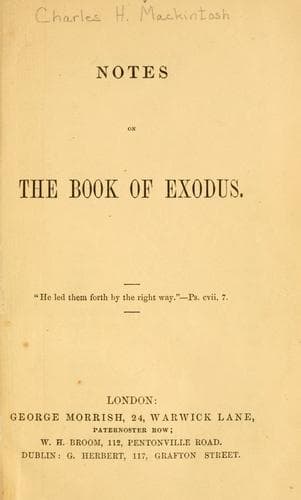
Notes on the book of ExodusMackintosh, Charles Henry
Religion
Notes on the book of Exodus
Mackintosh, Charles Henry
Bible. Exodus -- Commentaries
[16] It is interesting to note the position of this most solemn and
startling denunciation. It occurs at the close of a long epistle in
the progress of which the apostle had to rebuke some of the grossest
practical evils and doctrinal errors. How solemn, therefore, how full
of meaning the fact, that when he comes to pronounce his anathema, it
is not hurled at those who had introduced those errors and evils, but
at the man who loves not the Lord Jesus Christ! Why is this? Is it
because the Spirit of God makes little of errors and evils? Surely
not: the entire epistle unfolds His thoughts as to these. But the
truth is, when the heart is filled with love to the Lord Jesus Christ,
there is an effectual safeguard against all manner of false doctrine
and evil practice. If a man does not love Christ, there is no
accounting for the notions he may adopt, or the course he may pursue.
Hence the form and the position of the apostolic anathema.
CHAPTER XXXI.
The opening of this brief chapter records the divine call and the
divine qualification of "Bezaleel and Aholiab" to do the work of the
tabernacle of the congregation. "And the Lord spake unto Moses,
saying, 'See, _I have called_ by name Bezaleel, the son of Uri, the
son of Hur, of the tribe of Judah; and _I have filled_ him with the
spirit of God, in wisdom, and in understanding, and in knowledge, and
in all manner of workmanship.... And I, behold, _I have given_ with
him Aholiab, the son of Ahisamach, of the tribe of Dan; and in the
hearts of all that are wise-hearted _I have put_ wisdom, that they may
make all that _I have commanded_." Whether for "the work of the
tabernacle" of old, or "the work of the ministry" now, there should be
the divine selection, the divine call, the divine qualification, the
divine appointment, and all must be done according to the divine
commandment. Man could not select, call, qualify, or appoint to do the
work of the tabernacle; neither can he to do the work of the ministry.
Furthermore, no man could presume to appoint himself to do the work of
the tabernacle; neither can he to do the work of the ministry. It was,
it is, it must be, wholly and absolutely divine. Men may run as sent
of their fellow, or men may run of themselves; but let it be
remembered that all who run without being sent of God shall one day or
other be covered with shame and confusion of face. Such is the plain
and wholesome doctrine suggested by the words, "I have called," "I
have filled," "I have given," "I have put," "I have commanded." The
words of the Baptist must ever hold good--"A man can receive nothing
except it be given him from heaven." (John iii. 27.) He can therefore
have but little room to boast of himself, and just as little to be
jealous of his fellow.
Public-domain text, read in full here on John Shaqi.
Reviews
Reviews
No reviews yet
Be the first to share your thoughts on this work.
Elsewhere in the archive
Join the Discussion
Join the discussion
Sign in to leave a comment or review.
Sign InorCreate an account