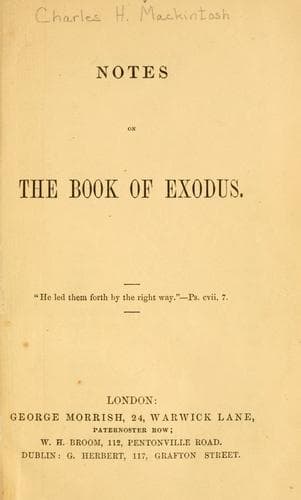
Notes on the book of ExodusMackintosh, Charles Henry
Religion
Notes on the book of Exodus
Mackintosh, Charles Henry
Bible. Exodus -- Commentaries
There is a profitable lesson to be learnt from a comparison of this
chapter with Genesis iv. "Tubal-cain was an instructor of every
artificer in brass and iron." The descendants of Cain were endowed
with unhallowed skill to make a cursed and groaning earth a delectable
spot, without the presence of God: "Bezaleel and Aholiab," on the
contrary, were endowed with divine skill to beautify a sanctuary which
was to be hallowed and blessed by the presence and glory of the God of
Israel.
Reader, let me ask you just to pause and put this solemn question to
your conscience,--Whether am I devoting whatever of skill or energy I
possess to the interests of the Church which is God's dwelling-place,
or to beautify an ungodly, Christless world? Say not in thine heart, I
am not divinely called or divinely qualified for the work of the
ministry. Remember that though all Israel were not Bezaleels or
Aholiabs, yet all could serve the interests of the sanctuary. There
was an open door for all to communicate. Thus it is now. Each one has
a place to occupy, a ministry to fulfill, a responsibility to
discharge; and you and I are at this moment either promoting the
interests of the house of God--the body of Christ--the Church, or
helping on the Godless schemes of a world yet stained with the blood
of Christ and the blood of all His martyred saints. Oh, let us deeply
ponder this, as in the presence of the great Searcher of hearts, whom
none can deceive--to whom all are known.
Our chapter closes with a special reference to the institution of the
Sabbath. It was referred to in chapter xvi, in connection with the
manna; it was distinctly enjoined in chapter xx, when the people were
formally put under law; and here we have it again, in connection with
the setting up of the tabernacle. Whenever the nation of Israel is
presented in some special position, or recognized as a people in
special responsibility, then the Sabbath is introduced. And let my
reader carefully note both the day and the mode in which it was to be
observed, and also the object for which it was instituted in Israel.
"Ye shall keep the Sabbath, therefore, for it is holy unto you: _every
one that defileth it shall surely be put to death_; for whosoever
doeth _any work_ therein, that soul shall be _cut off_ from among his
people. Six days may work be done; but _in the seventh_ is the Sabbath
of rest, holy to the Lord: whosoever doeth _any work_ in the Sabbath
day, _he shall surely be put to death_." This is as explicit and
absolute as any thing can be. It fixes "the seventh day" and none
other; and it positively forbids, on pain of death, all manner of
work. There can be no avoiding the plain sense of this. And be it
remembered that there is not so much as a single line of Scripture to
prove that the Sabbath has been changed, or the strict principles of
its observance in the smallest degree relaxed. If there be any
Scripture proof, let my reader look it out for his own satisfaction.
Public-domain text, read in full here on John Shaqi.
Reviews
Reviews
No reviews yet
Be the first to share your thoughts on this work.
Elsewhere in the archive
Join the Discussion
Join the discussion
Sign in to leave a comment or review.
Sign InorCreate an account