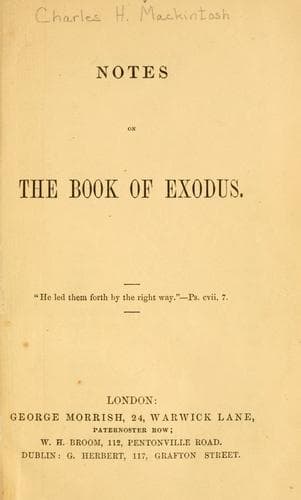
Notes on the book of ExodusMackintosh, Charles Henry
Religion
Notes on the book of Exodus
Mackintosh, Charles Henry
Bible. Exodus -- Commentaries
Now, let us inquire if indeed professing Christians do keep God's
Sabbath on the day and after the manner which He commanded. It were
idle to lose time in proving that they do not. Well, what are the
consequences of a single breach of the Sabbath? "_Cut off_"--"_put to
death_."
But, it will be said, we "are not under law, but under grace." Blessed
be God for the sweet assurance! Were we under law, there is not one
throughout the wide range of Christendom who should not long since
have fallen beneath the stone of judgment, even upon the one solitary
point of the Sabbath. But, if we are under grace, what is the day
which belongs to us? Assuredly, "the first day of the week"--"the
Lord's day." This is the Church's day--the resurrection day of Jesus,
who, having spent the Sabbath in the tomb, rose triumphant over all
the powers of darkness; thus leading His people out of the old
creation, and all that pertains thereto, into the new creation, of
which He is the Head, and of which the first day of the week is the
apt expression.
This distinction is worthy of the serious attention of the reader. Let
him examine it prayerfully in the light of Scripture. There may be
nothing and there may be a great deal in a mere name. In the present
instance, there is a great deal more involved in the distinction
between "the Sabbath" and "the Lord's day" than many Christians seem
to be aware of. It is very evident that the first day of the week gets
a place in the Word of God which no other day gets. No other day is
ever called by that majestic and elevated title, "The Lord's day."
Some, I am aware, deny that Rev. i. 10 refers to the first day of the
week; but I feel most fully assured that sound criticism and sound
exegesis do both warrant--yea, demand the application of that passage,
not to the day of Christ's advent in glory, but to the day of His
resurrection from the dead.
But most assuredly, the Lord's day is never once called the Sabbath.
So far from this, the two days are again and again spoken of in their
proper distinctness. Hence, therefore, my reader will have to keep
clear of two extremes. In the first place, he will have to avoid the
legalism which one finds so much linked with the term "Sabbath;" and,
in the second place, he will need to bear a very decided testimony
against every attempt to dishonor the Lord's day, or lower it to the
level of an ordinary day. The believer is delivered, most completely,
from the observance of "days, and months, and times, and years."
Association with a risen Christ has taken him clean out of all such
superstitious observances. But, while this is most blessedly true, we
see that "the first day of the week" has a place assigned to it in the
New Testament which no other has. Let the Christian give it that
place. It is a sweet and happy privilege, not a grievous yoke.
Public-domain text, read in full here on John Shaqi.
Reviews
Reviews
No reviews yet
Be the first to share your thoughts on this work.
Elsewhere in the archive
Join the Discussion
Join the discussion
Sign in to leave a comment or review.
Sign InorCreate an account