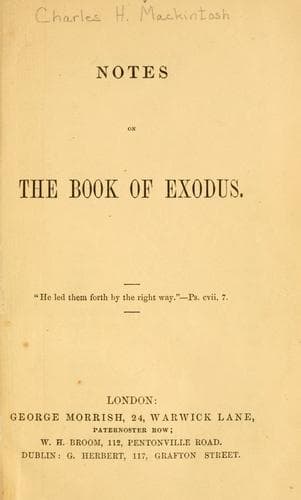
Notes on the book of ExodusMackintosh, Charles Henry
Religion
Notes on the book of Exodus
Mackintosh, Charles Henry
Bible. Exodus -- Commentaries
"Now, Moses kept the flock of Jethro, his father-in-law, the priest of
Midian; and he led the flock to the backside of the desert, and came
to the mountain of God, even to Horeb." (Exod. iii. 1.) Here, then, we
have a marvelous change of circumstances. In Genesis, chapter xlvi.
31, we read, "Every shepherd is an abomination to the Egyptians;" and
yet Moses, who was "learned in all the wisdom of the Egyptians," is
transferred from the Egyptian court to the back of a mountain to tend
a flock of sheep, and to be educated for the service of God.
Assuredly, this is not "the manner of man." This is not nature's line
of things. Flesh and blood could not understand this. We should have
thought that Moses' education was finished when he had become master
of all Egypt's wisdom, and that, moreover, in immediate connection
with the rare advantages which a court life affords. We should have
expected to find in one so highly favored, not only a solid and varied
education, but also such an exquisite polish as would fit him for any
sphere of action to which he might be called. But then, to find such a
man with such attainments, called away from such a position to mind
sheep at the back of a mountain, is something entirely beyond the
utmost stretch of human thought and feeling. It lays prostrate in the
dust all man's pride and glory. It declares plainly that this world's
appliances are of little value in the divine estimation; yea, they are
as "dung and dross," not only in the eyes of the Lord, but also in the
eyes of all those who have been taught in His school.
There is a very wide difference between human and divine education.
The former has for its end the refinement and exaltation of nature;
the latter begins with withering it up and setting it aside. "The
natural man receiveth not the things of the Spirit of God; for they
are foolishness unto him; neither can he know them, because they are
spiritually discerned." (1 Cor. ii. 14.) Educate the "natural man" as
much as you please, and you cannot make him a "spiritual man." "That
which is born of the flesh is flesh; and that which is born of the
Spirit is spirit." (John iii. 6.) If ever an educated "natural man"
might look for success in the service of God, Moses might have counted
upon it; he was "grown," he was "learned," he was "mighty in word and
deed," and yet he had to learn something at "the backside of the
desert" which Egypt's schools could never have taught him. Paul learnt
more in Arabia than ever he had learnt at the feet of Gamaliel.[4]
None can teach like God; and all who will learn _of_ Him must be alone
_with_ Him.
Public-domain text, read in full here on John Shaqi.
Reviews
Reviews
No reviews yet
Be the first to share your thoughts on this work.
Join the Discussion
Join the discussion
Sign in to leave a comment or review.
Sign InorCreate an account