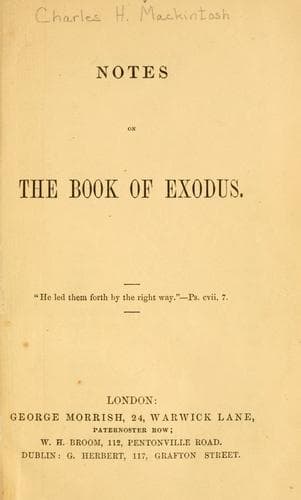
Notes on the book of ExodusMackintosh, Charles Henry
Religion
Notes on the book of Exodus
Mackintosh, Charles Henry
Bible. Exodus -- Commentaries
"And the Lord said, 'I have surely seen the affliction of My people
which are in Egypt, and have heard their cry by reason of their
taskmasters; for I know their sorrows; and I am come down to deliver
them out of the hand of the Egyptians, and to bring them up out of
that land unto a good land and a large, unto a land flowing with milk
and honey.... Now, therefore, behold, the cry of the children of
Israel is come unto Me; and I have also seen the oppression wherewith
the Egyptians oppress them.'" (Ver. 7-9.) Here the absolute, free,
unconditional grace of the God of Abraham, and the God of Abraham's
seed, shines forth in all its native brightness, unhindered by the
"ifs" and "buts," the vows, resolutions, and conditions of man's legal
spirit. God had come down to display Himself, in sovereign grace, to
do the whole work of salvation, to accomplish His promise made to
Abraham, and repeated to Isaac and Jacob. He had not come down to see
if, indeed, the subjects of His promise were in such a condition as to
_merit_ His salvation: it was sufficient for Him that they _needed_
it. Their oppressed state, their sorrows, their tears, their sighs,
their heavy bondage, had all come in review before Him; for, blessed
be His name, He counts His people's sighs, and puts their tears into
His bottle. He was not attracted by their excellencies or their
virtues. It was not on the ground of aught that was good in them,
either seen or foreseen, that He was about to visit them, for He knew
what was in them. In one word, we have the true ground of His gracious
acting set before us in the words, "I am the God of Abraham," and "I
have seen the affliction of My people."
These words reveal a great fundamental principle in the ways of God.
It is on the ground of what He is that He ever acts. "I AM," secures
all for "MY PEOPLE." Assuredly, He was not going to leave _His_ people
amid the brick-kilns of Egypt, and under the lash of Pharaoh's
taskmasters. They were His people, and He would act toward them in a
manner worthy of Himself. To be His people,--to be the favored objects
of Jehovah's electing love--the subjects of His unconditional promise,
settled everything. Nothing should hinder the public display of His
relationship with those for whom His eternal purpose had secured the
land of Canaan. He had come down to deliver them; and the combined
power of earth and hell could not hold them in captivity one hour
beyond His appointed time. He might and did use Egypt as a school, and
Pharaoh as a schoolmaster; but when the needed work was accomplished,
both the school and the schoolmaster were set aside, and His people
were brought forth with a high hand and an outstretched arm.
Public-domain text, read in full here on John Shaqi.
Reviews
Reviews
No reviews yet
Be the first to share your thoughts on this work.
Join the Discussion
Join the discussion
Sign in to leave a comment or review.
Sign InorCreate an account