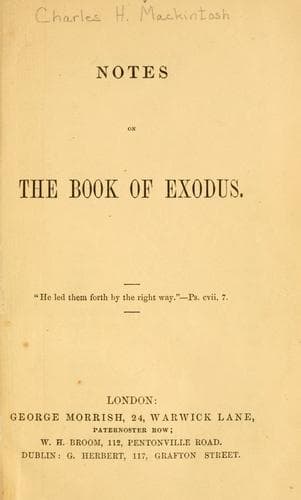
Notes on the book of ExodusMackintosh, Charles Henry
Religion
Notes on the book of Exodus
Mackintosh, Charles Henry
Bible. Exodus -- Commentaries
But although it was to the elect of God that Moses was commanded to
say, "I AM hath sent me unto you," yet is there deep solemnity and
reality in that name when looked at with reference to the unbeliever.
If one who is yet in his sins contemplates, for a moment, this amazing
title, he cannot, surely, avoid asking himself the question, How do I
stand as to this Being who calls Himself, "I AM THAT I AM"? If,
indeed, it be true that HE IS, then what _is_ He to _me_? What am _I_
to write over against this solemn name, "I AM"? I shall not rob this
question of its characteristic weight and power by any words of my
own; but I pray that God the Holy Ghost may make it searching to the
conscience of any reader who really needs to be searched thereby.
I cannot close this section without calling the attention of the
Christian reader to the deeply interesting declaration contained in
the fifteenth verse,--"And God said, moreover, unto Moses, 'Thus shalt
thou say unto the children of Israel, The Lord God of your fathers,
the God of Abraham, the God of Isaac, and the God of Jacob, hath sent
me unto you: _this is My name forever, and this is My memorial to all
generations_.'" This statement contains a very important truth--a
truth which many professing Christians seem to forget, namely, that
God's relationship with Israel is an eternal one. He is just as much
Israel's God now as when He visited them in the land of Egypt. Only,
because of rejecting their Messiah, they are, in His governmental
dealings, set aside for a time. But His word is clear and emphatic:
"This is My name forever." He does not say, This is My name for a
time, so long as they continue what they ought to be. No; "This is My
name _forever_, and this is My memorial unto _all generations_." Let
my reader ponder this. "God hath not cast away His people which He
foreknew." (Rom. xi. 2.) They are His people still, whether obedient
or disobedient, united together or scattered abroad, manifested to the
nations or hidden from their view. They are His people, and He is
their God. Exodus iii. 15 is unanswerable. The professing church has
no warrant whatever for ignoring a relationship which God says is to
endure "forever." Let us beware how we tamper with this weighty word,
"forever." If we say it does not mean forever when applied to Israel,
what proof have we that it means forever when applied to us? God
means what He says; and He will, ere long, make manifest to all the
nations of the earth that His connection with Israel is one which
shall outlive all the revolutions of time. "The gifts and calling of
God are without repentance." When He said, "This is My name forever,"
He spoke absolutely. "I AM" declared Himself to be Israel's God
forever; and all the Gentiles shall be made to bow to this; and to
know, moreover, that all God's providential dealings with them, and
all their destinies, are connected, in some way or other, with that
favored and honored, though now judged and scattered, people.
Public-domain text, read in full here on John Shaqi.
Reviews
Reviews
No reviews yet
Be the first to share your thoughts on this work.
Join the Discussion
Join the discussion
Sign in to leave a comment or review.
Sign InorCreate an account