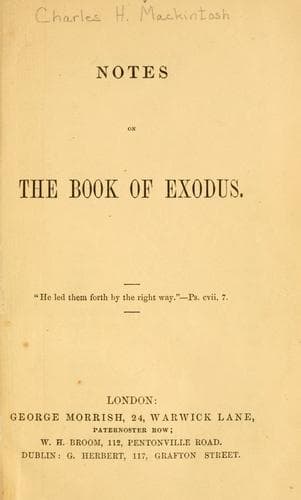
Notes on the book of ExodusMackintosh, Charles Henry
Religion
Notes on the book of Exodus
Mackintosh, Charles Henry
Bible. Exodus -- Commentaries
We might suppose that Moses had seen and heard enough to set his fears
entirely aside. The consuming fire in the unconsumed bush, the
condescending grace, the precious, endearing, and comprehensive
titles, the divine commission, the assurance of the divine
presence,--all these might have quelled every anxious thought, and
have imparted a settled assurance to the heart. Still, however, Moses
raises questions, and still God answers them; and, as we have
remarked, each successive question brings out fresh grace. "And the
Lord said unto him, 'What is that in thine hand?' And he said, 'A
rod.'" The Lord would just take him as he was, and use what he had in
his hand. The rod with which he had tended Jethro's sheep was about to
be used to deliver the Israel of God, to chastise the land of Egypt,
to make a way through the deep, for the ransomed of the Lord to pass
over, and to bring forth water from the flinty rock to refresh
Israel's thirsty hosts in the desert. God takes up the weakest
instruments to accomplish His mightiest ends. "A rod," "a ram's horn,"
"a cake of barley meal," "an earthen pitcher," "a shepherd's
sling,"--anything, in short, when used of God, will do the appointed
work. Men imagine that splendid ends can only be reached by splendid
means; but such is not God's way. He can use a crawling worm as well
as a scorching sun, a gourd as well as a vehement east wind. (See
Jonah.)
But Moses had to learn a deep lesson, both as to the rod and the hand
that was to use it. He had to learn, and the people had to be
convinced. "And He said, 'Cast it on the ground.' And he cast it on
the ground, and it became a serpent; and Moses fled from before it.
And the Lord said unto Moses, 'Put forth thine hand and take it by the
tail.' And he put forth his hand and caught it, and it became a rod
in his hand; 'that they may believe that the Lord God of their
fathers, the God of Abraham, the God of Isaac, and the God of Jacob,
hath appeared unto thee.'" This is a deeply significant sign. The rod
became a serpent, so that Moses fled from it; but, being commissioned
by Jehovah, he took the serpent by the tail, and it became a rod.
Nothing could more aptly express the idea of Satan's power being
turned against himself. This is largely exemplified in the ways of
God. Moses himself was a striking example. The serpent is entirely
under the hand of Christ; and when he has reached the highest point in
his mad career, he shall be hurled into the lake of fire, there to
reap the fruits of his work throughout eternity's countless ages.
"That old serpent, the accuser, and the adversary," shall be eternally
crushed beneath the rod of God's Anointed.
"Then the end--beneath His rod,
Man's last enemy shall fall;
Hallelujah! Christ in God,
God in Christ, is all in all."
Public-domain text, read in full here on John Shaqi.
Reviews
Reviews
No reviews yet
Be the first to share your thoughts on this work.
Join the Discussion
Join the discussion
Sign in to leave a comment or review.
Sign InorCreate an account