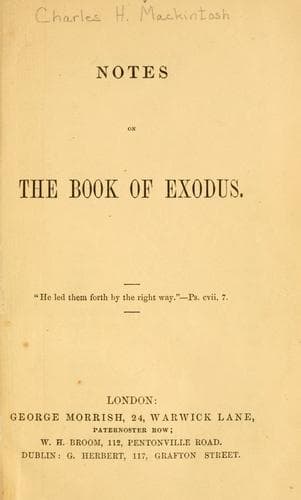
Notes on the book of ExodusMackintosh, Charles Henry
Religion
Notes on the book of Exodus
Mackintosh, Charles Henry
Bible. Exodus -- Commentaries
However, Moses at length consents to go; but ere he is fully equipped
for his work, he must pass through another deep exercise,--yea, he
must have the sentence of death inscribed by the hand of God upon his
very nature. He had learnt deep lessons at "the backside of the
desert;" he is called to learn something deeper still, "by the way in
the inn." It is no light matter to be the Lord's servant. No ordinary
education will qualify a man for such a position. Nature must be put
in the place of death, and kept there. "We had the sentence of death
in ourselves, that we should not trust in ourselves, but in God which
raiseth the dead." (2 Cor. i. 9.) Every successful servant will need
to know something of this. Moses was called to enter into it, in his
own experience, ere he was morally qualified. He was about to sound in
the ears of Pharaoh the following deeply solemn message: "Thus saith
the Lord, 'Israel is My son, even My first-born: and I say unto thee,
Let My son go, that he may serve Me: and if thou refuse to let him go,
behold I will slay thy son, even thy first-born.'" Such was to be his
message to Pharaoh,--a message of death, a message of judgment; and,
at the same time, his message to Israel was a message of life and
salvation. But, be it remembered, that the man who will speak, on
God's behalf, of death and judgment, life and salvation, must, ere he
does so, enter into the practical power of these things in his own
soul. Thus it was with Moses. We have seen him, at the very outset, in
the place of death, typically; but this was a different thing from
entering into the experience of death in his own person. Hence we
read, "And it came to pass, by the way in the inn, that the Lord met
him, and sought to kill him. Then Zipporah took a sharp stone, and cut
off the foreskin of her son, and cast it at his feet, and said,
'Surely, a bloody husband art thou to me.' So He let him go: then she
said, 'A bloody husband thou art, because of the circumcision.'" This
passage lets us into a deep secret in the personal and domestic
history of Moses. It is very evident that Zipporah's heart had, up to
this point, shrunk from the application of _the knife_ to that around
which the affections of nature were entwined. She had avoided that
mark which had to be set in the flesh of every member of the Israel of
God. She was not aware that her relationship with Moses was one
involving death to nature. She recoiled from the cross. This was
natural. But Moses had yielded to her in the matter; and this explains
to us the mysterious scene "in the inn." If Zipporah refuses to
circumcise her _son_, Jehovah will lay His hand upon her _husband_;
and if Moses spares the feelings of his wife, Jehovah will "seek to
kill him." The sentence of death must be written on nature; and if we
seek to avoid it in one way, we shall have to encounter it in another.
Public-domain text, read in full here on John Shaqi.
Reviews
Reviews
No reviews yet
Be the first to share your thoughts on this work.
Join the Discussion
Join the discussion
Sign in to leave a comment or review.
Sign InorCreate an account