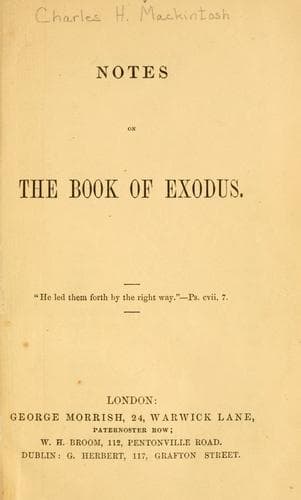
Notes on the book of ExodusMackintosh, Charles Henry
Religion
Notes on the book of Exodus
Mackintosh, Charles Henry
Bible. Exodus -- Commentaries
There was no need for the blood of the Lamb in creation as it came
fresh from the hand of the Creator, exhibiting, in every stage and
every department of it, the beauteous impress of His hand--"the
infallible proofs" of "His eternal power and Godhead" (Rom. i.); but
when, "by one man," sin was introduced into the world, then came out
the higher, richer, fuller, deeper thought of redemption by the blood
of the Lamb. This glorious truth first broke through the thick clouds
which surrounded our first parents, as they retreated from the garden
of Eden; its glimmerings appear in the types and shadows of the Mosaic
economy; it burst upon the World in full brightness when "the
dayspring from on high" appeared in the Person of "God manifest in the
flesh;" and its rich and rare results will be realized when the
white-robed, palm-bearing multitude shall cluster round the throne of
God and the Lamb, and the whole creation shall rest beneath the
peaceful sceptre of the Son of David.
Now, the lamb taken on the tenth day, and kept up until the fourteenth
day, shows us Christ foreordained of God from eternity, but manifest
for us in time. God's eternal purpose in Christ becomes the foundation
of the believer's peace. Nothing short of this would do. We are
carried back far beyond creation, beyond the bounds of time, beyond
the entrance in of sin and everything that could possibly affect the
ground-work of our peace. The expression, "foreordained before the
foundation of the world," conducts us back into the unfathomed depths
of eternity, and shows us God forming His own counsels of redeeming
love, and basing them all upon the atoning blood of His own precious,
spotless Lamb. Christ was ever the primary thought in the divine mind;
and hence, the moment He began to speak or act, He took occasion to
shadow forth that One who occupied the highest place in His counsels
and affections; and, as we pass along the current of inspiration, we
find that every ceremony, every rite, every ordinance, and every
sacrifice pointed forward to "the Lamb of God that taketh away the sin
of the world," and not one more strikingly than the passover. The
paschal lamb, with all the attendant circumstances, forms one of the
most profoundly interesting and deeply instructive types of Scripture.
In the interpretation of Exodus xii, we have to do with _one_ assembly
and _one_ sacrifice.--"The whole assembly of the congregation of
Israel shall kill _it_ in the evening." (Ver. 6.) It is not so much a
number of families with several lambs--a thing quite true in
itself--as one assembly and one lamb. Each house was but the local
expression of the whole assembly gathered round the lamb. The antitype
of this we have in the whole Church of God, gathered by the Holy
Ghost, in the name of Jesus, of which each separate assembly, wherever
convened, should be the local expression.
Public-domain text, read in full here on John Shaqi.
Reviews
Reviews
No reviews yet
Be the first to share your thoughts on this work.
Elsewhere in the archive
Join the Discussion
Join the discussion
Sign in to leave a comment or review.
Sign InorCreate an account