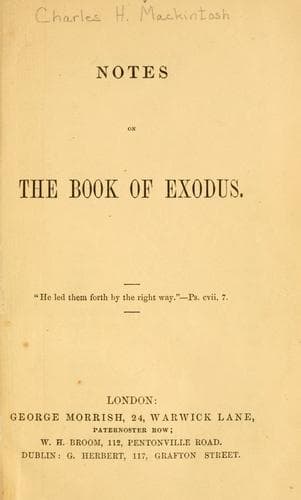
Notes on the book of ExodusMackintosh, Charles Henry
Religion
Notes on the book of Exodus
Mackintosh, Charles Henry
Bible. Exodus -- Commentaries
"And they shall take of the blood, and strike it on the two side-posts
and on the upper door-post of the houses, wherein they shall eat it.
And they shall eat the flesh in that night, roast with fire, and
unleavened bread; and with bitter herbs they shall eat it. Eat not of
it raw, nor sodden at all with water, but roast with fire; his head
with his legs, and with the purtenance thereof." (Ver. 7-9.) We have
to contemplate the paschal lamb in two aspects, namely, as the ground
of peace, and the centre of unity. The blood on the lintel secured
Israel's peace.--"When I see the blood, I will pass over you." (Ver.
13.) There was nothing more required in order to enjoy settled peace,
in reference to the destroying angel, than the application of the
blood of sprinkling. Death had to do its work in every house
throughout the land of Egypt. "It is appointed unto men once to die."
But God, in His great mercy, found an unblemished substitute for
Israel, on which the sentence of death was executed. Thus God's claims
and Israel's need were met by one and the same thing, namely, the
blood of the lamb. That blood outside proved that _all_ was perfectly,
because divinely, settled; and therefore perfect peace reigned within.
A shade of doubt in the bosom of an Israelite would have been a
dishonor offered to the divinely appointed ground of peace--the blood
of atonement.
True it is that each one within the blood-sprinkled door would
necessarily feel that were he to receive his due reward, the sword of
the destroyer should most assuredly find its object in him; but then
the lamb was treated in his stead. This was the solid foundation of
his peace. The judgment that was due to him fell upon a divinely
appointed victim; and believing this, he could feed in peace within. A
single doubt would have made Jehovah a liar; for He had said, "When
_I_ see the _blood_, I will pass over you." This was enough. It was no
question of personal worthiness. Self had nothing whatever to do in
the matter. All under the cover of the blood were safe. They were not
merely in a salvable state, they were _saved_. They were not hoping or
praying to be saved; they knew it as an assured fact, on the authority
of that Word which shall endure throughout all generations. Moreover,
they were not partly saved and partly exposed to judgment; they were
wholly saved. The blood of the lamb and the word of the Lord formed
the foundation of Israel's peace on that terrible night in which
Egypt's first-born were laid low. If a hair of an Israelite's head
could be touched, it would have proved Jehovah's word void, and the
blood of the lamb valueless.
Public-domain text, read in full here on John Shaqi.
Reviews
Reviews
No reviews yet
Be the first to share your thoughts on this work.
Elsewhere in the archive
Join the Discussion
Join the discussion
Sign in to leave a comment or review.
Sign InorCreate an account