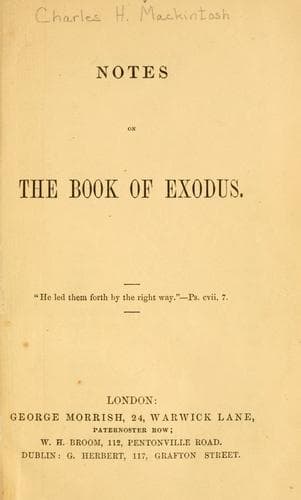
Notes on the book of ExodusMackintosh, Charles Henry
Religion
Notes on the book of Exodus
Mackintosh, Charles Henry
Bible. Exodus -- Commentaries
Hence, therefore, the paschal lamb, as the ground of Israel's peace,
is a marked and beautiful type of Christ as the ground of the
believer's peace. There was nothing to be added to the blood on the
lintel; neither is there anything to be added to the blood on the
mercy-seat. The "unleavened bread" and "bitter herbs" were necessary,
but not as forming, either in whole or in part, the ground of peace.
They were for the inside of the house, and formed the characteristics
of the communion there; but THE BLOOD OF THE LAMB WAS THE FOUNDATION
OF EVERYTHING. It saved them from death, and introduced them into a
scene of life, light, and peace. It formed the link between God and
His redeemed people. As a people linked with God, on the ground of
accomplished redemption, it was their high privilege to meet certain
responsibilities; but these responsibilities did not form the link,
but merely flowed out of it.
And I would further remind my reader that the obedient _life_ of
Christ is not set forth in Scripture as the procuring cause of our
forgiveness. It was His death upon the cross that opened those
everlasting floodgates of love which else should have remained pent up
forever. If He had remained to this very hour, going through the
cities of Israel, "doing good," the vail of the temple would continue
unrent, to bar the worshiper's approach to God. It was His death that
rent that mysterious curtain "from top to bottom." It is "by _His
stripes_," not by His obedient life, that "we are healed;" and those
"stripes" He endured _on the cross_, and no where else. His own words,
during the progress of His blessed life, are quite sufficient to
settle this point.--"I have a baptism to be baptized with; and how am
I straitened till it be accomplished." (Luke xii. 50.) To what does
this refer but to His death upon the cross, which was the
accomplishment of His baptism and the opening up of a righteous vent
through which His love might freely flow out to the guilty sons of
Adam? Again, He says, "Except a corn of wheat fall into the ground and
die, it abideth alone." (John xii. 24.) He was that precious "corn of
wheat;" and He should have remained forever "alone," even though
incarnate, had He not, by His death upon the accursed tree, removed
out of the way everything that could have hindered the union of His
people with Him in resurrection. "If it die, it bringeth forth much
fruit."
Public-domain text, read in full here on John Shaqi.
Reviews
Reviews
No reviews yet
Be the first to share your thoughts on this work.
Elsewhere in the archive
Join the Discussion
Join the discussion
Sign in to leave a comment or review.
Sign InorCreate an account