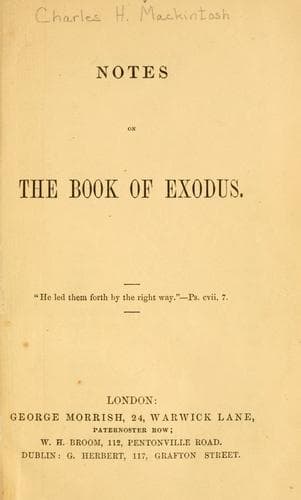
Notes on the book of ExodusMackintosh, Charles Henry
Religion
Notes on the book of Exodus
Mackintosh, Charles Henry
Bible. Exodus -- Commentaries
My reader cannot too carefully ponder this subject. It is one of
immense weight and importance. He has to remember two points in
reference to this entire question, namely, that there could be no
union with Christ, save in resurrection; and that Christ _only_
suffered for sins on the cross. We are not to suppose that incarnation
was, by any means, Christ taking us into union with Himself. This
could not be. How could sinful flesh be thus united? The body of sin
had to be destroyed by death. Sin had to be put away according to the
divine requirement; all the power of the enemy had to be abolished.
How was all this to be done? Only by the precious, spotless Lamb of
God submitting to the death of the cross. "It became Him, for whom are
all things, and by whom are all things, in bringing many sons unto
glory, to make the Captain of their salvation perfect _through
sufferings_." (Heb. ii. 10.) "Behold, I cast out devils, and I do
cures to-day and to-morrow, and _the third day I shall be perfected_."
(Luke xiii. 32.) The expressions "perfect" and "perfected" in the
above passages, do not refer to Christ in His own Person abstractedly,
for He was perfect from all eternity, as Son of God; and as to His
humanity, He was absolutely perfect likewise. But then, as "the
Captain of salvation"--as "bringing many sons unto glory"--as
"bringing forth much fruit"--as associating a redeemed people _with_
Himself,--He had to reach "the third day" in order to be "perfected."
He went down _alone_ into the "horrible pit, and miry clay;" but
directly He plants His "foot on the rock" of resurrection. He
associates with Himself the "many sons." (Psalm xl. 1-3.) He fought
the fight alone; but, as the mighty Conqueror, He scatters around Him,
in rich profusion, the spoils of victory, that we might gather them up
and enjoy them forever.
Moreover, we are not to regard the cross of Christ as a mere
circumstance in a life of sin-bearing. It was _the_ grand and only
scene of sin-bearing. "His own self bare our sins in His own body on
the tree." (1 Peter ii. 24.) He did not bear them any where else. He
did not bear them in the manger, nor in the wilderness, nor in the
garden; but ONLY "ON THE TREE." He never had aught to say to sin, save
on the cross; and there He bowed His head, and yielded up His precious
life, under the accumulated weight of His people's sins. Neither did
He ever suffer at the hand of God, save on the cross; and there
Jehovah hid His face from Him because He was "made sin." (2 Cor. v.)
Public-domain text, read in full here on John Shaqi.
Reviews
Reviews
No reviews yet
Be the first to share your thoughts on this work.
Elsewhere in the archive
Join the Discussion
Join the discussion
Sign in to leave a comment or review.
Sign InorCreate an account