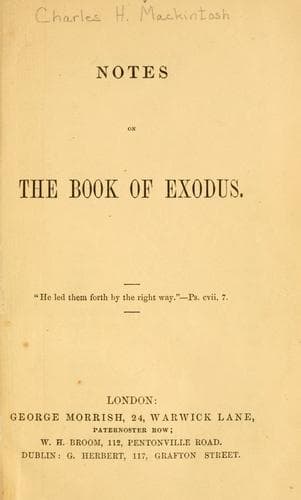
Notes on the book of ExodusMackintosh, Charles Henry
Religion
Notes on the book of Exodus
Mackintosh, Charles Henry
Bible. Exodus -- Commentaries
And first, then, we read, "They shall eat the flesh in that night,
roast with fire, and unleavened bread; and with bitter herbs they
shall eat it. Eat not of it raw, nor sodden at all with water, but
roast with fire; his head with his legs, and with the purtenance
thereof." (Ver. 8, 9.) The lamb round which the congregation was
assembled, and on which it feasted, was a roasted lamb--a lamb which
had undergone the action of fire. In this we see "Christ our passover"
presenting Himself to the action of the fire of divine holiness and
judgment which found in Him a perfect material. He could say, "Thou
hast proved mine heart; thou hast visited me in the night; thou hast
tried me and shalt find nothing: I am purposed that my mouth shall not
transgress." (Psalm xvii. 3.) All in Him was perfect. The fire tried
Him, and there was no dross. "His head with his legs and with the
purtenance thereof." That is to say, the seat of His understanding,
His outward walk, with all that pertained thereto--all was submitted
to the action of the fire, and all was entirely perfect. The process
of roasting was therefore deeply significant, as is every circumstance
in the ordinances of God. Nothing should be passed over, because all
is pregnant with meaning.
"Eat not of it raw, nor sodden at all with water." Had it been eaten
thus, there would have been no expression of the great truth which it
was the divine purpose to shadow forth; namely, that our paschal Lamb
was to endure, on the cross, the fire of Jehovah's righteous wrath,--a
truth of infinite preciousness to the soul. We are not merely under
the shelter of the blood of the Lamb, but we feed, by faith, upon the
Person of the Lamb. Many of us come short here. We are apt to rest
satisfied with being saved by what Christ has done for us, without
cultivating holy communion with Himself. His loving heart could never
be satisfied with this. He has brought us nigh to Himself, that we
might enjoy Him, that we might feed on Him, and delight in Him. He
presents Himself to us as the One who has endured, to the uttermost,
the intense fire of the wrath of God, that He may, in this wondrous
character, be the food of our ransomed souls.
Public-domain text, read in full here on John Shaqi.
Reviews
Reviews
No reviews yet
Be the first to share your thoughts on this work.
Elsewhere in the archive
Join the Discussion
Join the discussion
Sign in to leave a comment or review.
Sign InorCreate an account