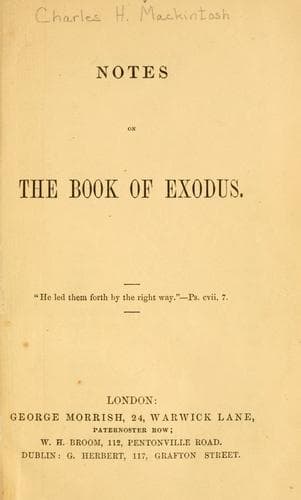
Notes on the book of ExodusMackintosh, Charles Henry
Religion
Notes on the book of Exodus
Mackintosh, Charles Henry
Bible. Exodus -- Commentaries
But how was this lamb to be eaten? "With unleavened bread and bitter
herbs." Leaven is invariably used, throughout Scripture, as
emblematical of evil. Neither in the Old nor in the New Testament is
it ever used to set forth anything pure, holy, or good. Thus, in this
chapter, "the feast of unleavened bread" is the type of that practical
separation from evil which is the proper result of being washed from
our sins in the blood of the Lamb, and the proper accompaniment of
communion with His sufferings. Naught but unleavened bread could at
all comport with a roasted lamb. A single particle of that which was
the marked type of evil, would have destroyed the moral character of
the entire ordinance. How could we connect any species of evil with
our fellowship with a suffering Christ? Impossible. All who enter, by
the power of the Holy Ghost, into the meaning of the cross will
assuredly, by the same power, put away leaven from all their borders.
"For even Christ our passover is sacrificed for us: _therefore_ let us
keep the feast, not with old leaven, neither with the leaven of malice
and wickedness; but with the unleavened bread of sincerity and truth."
(1 Cor. v. 7, 8.) The feast spoken of in this passage is that which,
in the life and conduct of the Church, corresponds with the feast of
unleavened bread. This latter lasted "seven days;" and the Church
collectively, and the believer individually, are called to walk in
practical holiness, during the seven days, or entire period, of their
course here below; and this, moreover, as the direct result of being
washed in the blood, and having communion with the sufferings of
Christ.
The Israelite did not put away leaven in order to be saved, but
because he was saved; and if he failed to put away leaven, it did not
raise the question of security through the blood, but simply of
fellowship with the assembly. "Seven days shall there be no leaven
found in your houses: for whosoever eateth that which is leavened,
even that soul shall be cut off from the congregation of Israel,
whether he be a stranger, or born in the land." (Ver. 19.) The cutting
off of an Israelite from the congregation answers precisely to the
suspension of a Christian's fellowship, if he be indulging in that
which is contrary to the holiness of the divine presence. God cannot
tolerate evil. A single unholy thought will interrupt the soul's
communion; and until the soil contracted by any such thought is got
rid of by confession, founded on the advocacy of Christ, the communion
cannot possibly be restored. (See 1 John i. 5-10.) The true-hearted
Christian rejoices in this. He can ever "give thanks at the
remembrance of God's holiness." He would not, if he could, lower the
standard a single hair's breadth. It is his exceeding joy to walk in
company with One who will not go on, for a moment, with a single jot
or tittle of "leaven."
Public-domain text, read in full here on John Shaqi.
Reviews
Reviews
No reviews yet
Be the first to share your thoughts on this work.
Elsewhere in the archive
Join the Discussion
Join the discussion
Sign in to leave a comment or review.
Sign InorCreate an account