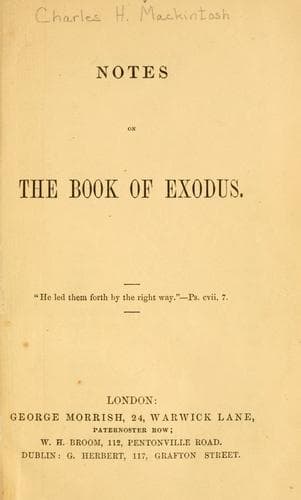
Notes on the book of ExodusMackintosh, Charles Henry
Religion
Notes on the book of Exodus
Mackintosh, Charles Henry
Bible. Exodus -- Commentaries
Blessed be God, we know that nothing can ever snap asunder the link
which binds the true believer to Him. We are "saved in the Lord," not
with a temporary or conditional, but "with an everlasting salvation."
But then salvation and communion are not the same thing. Many are
saved who do not know it; and many, also, who do not enjoy it. It is
quite impossible that I can enjoy a blood-stained lintel if I have
leavened borders. This is an axiom in the divine life. May it be
written on our hearts! Practical holiness, though not the basis of our
_salvation_, is intimately connected with our _enjoyment_ thereof. An
Israelite was not saved by unleavened bread, but by the blood; and yet
leaven would have cut him off from communion. And as to the Christian,
he is not saved by his practical holiness, but by the blood; but if he
indulges in evil, in thought, word, or deed, he will have no true
enjoyment of salvation, and no true communion with the Person of the
Lamb.
This, I cannot doubt, is the secret of much of the spiritual
barrenness and lack of settled peace which one finds amongst the
children of God. They are not cultivating holiness; they are not
keeping "the feast of unleavened bread." The blood is on the lintel,
but the leaven within their borders keeps them from enjoying the
security which the blood provides. The allowance of evil destroys our
fellowship, though it does not break the link which binds our souls
eternally to God. Those who belong to God's assembly must be holy.
They have not only been delivered from the guilt and consequences of
sin, but also from the practice of it, the power of it, and the love
of it. The very fact of being delivered by the blood of the paschal
lamb, rendered Israel responsible to put away leaven from all their
quarters. They could not say, in the frightful language of the
antinomian, Now that we are delivered, we may conduct ourselves as we
please. By no means. If they were saved _by grace_, they were saved
_to holiness_. The soul that can take occasion, from the freedom of
divine grace and the completeness of the redemption which is in Christ
Jesus, to "continue in sin," proves very distinctly that he
understands neither the one nor the other.
Public-domain text, read in full here on John Shaqi.
Reviews
Reviews
No reviews yet
Be the first to share your thoughts on this work.
Elsewhere in the archive
Join the Discussion
Join the discussion
Sign in to leave a comment or review.
Sign InorCreate an account