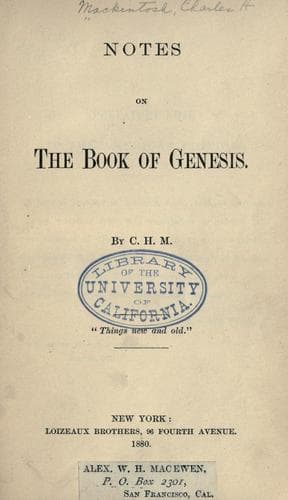
Notes on the Book of GenesisMackintosh, Charles Henry
Religion
Notes on the Book of Genesis
Mackintosh, Charles Henry
Bible. Genesis -- Commentaries
In this chapter we find the man of God actually exposing himself to the
rebuke and reproach of the men of the world, by reason of his actings
when under the power of unbelief. Thus it must ever be. Nothing but
faith can impart true elevation to a man's course and character. We
may, it is true, see some who are naturally upright and honorable in
their ways, yet nature's uprightness and honor cannot be trusted: they
rest on a bad foundation, and are liable to give way at any moment. It
is only faith which can impart a truly elevated moral tone, because it
connects the soul in living power with God, the only Source of true
morality. And it is a remarkable fact that, in the case of all those
whom God has graciously taken up, we see that, when off the path of
faith, they sank even lower than other men. This will account for
Abraham's conduct in this part of his history.
But there is another point of much interest and value brought out here.
We find that Abraham had harbored an evil thing for a number of years:
he had, it seems, started upon his course with a certain reserve in his
soul, which reserve was the result of his want of full, unqualified
confidence in God. Had he been able fully to trust God in reference to
Sarah, there would have been no need of any reserve or subterfuge
whatever. God would have fenced her round about from every ill; and who
can harm those who are the happy subjects of his unslumbering
guardianship? However, through mercy, Abraham is enabled to bring out
the root of the whole matter,--to confess and judge it thoroughly, and
get rid of it. This is the true way to act. There can be no real
blessing and power till every particle of leaven is brought forth into
the light and there trampled under foot. God's patience is exhaustless.
He can wait. He can bear with us; but he never will conduct a soul to
the culminating point of blessing and power while leaven remains known
and unjudged. Thus much as to Abimelech and Abraham. Let us now look at
the moral dignity of the latter, in the view of God.
In the history of God's people, whether we look at them as a whole, or
as individuals, we are often struck with the amazing difference between
what they are in God's view, and what they are in the view of the
world. God sees his people in Christ. He looks at them through Christ;
and hence he sees them "without spot, or wrinkle, or any such thing."
They are as Christ is before God. They are perfected forever, as to
their standing in Christ. "They are not in the flesh but in the
Spirit."
But, in themselves, they are poor, feeble, imperfect, stumbling,
inconsistent creatures; and, inasmuch as it is what they are in
themselves, and that alone, that the world takes knowledge of,
therefore it is that the difference seems so great between the divine
and the human estimate.
Public-domain text, read in full here on John Shaqi.
Reviews
Reviews
No reviews yet
Be the first to share your thoughts on this work.
Elsewhere in the archive
Join the Discussion
Join the discussion
Sign in to leave a comment or review.
Sign InorCreate an account