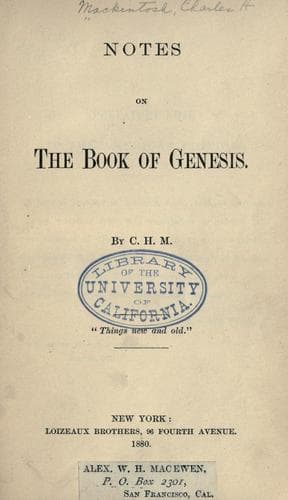
Notes on the Book of GenesisMackintosh, Charles Henry
Religion
Notes on the Book of Genesis
Mackintosh, Charles Henry
Bible. Genesis -- Commentaries
Yet it is God's prerogative to set forth the beauty, the dignity, and
the perfection of his people. It is his exclusive prerogative, inasmuch
as it is he himself who has bestowed those things. They are only comely
through the comeliness which he has put upon them; and it is therefore
due to him to declare what that comeliness is; and truly he does it in
a manner worthy of himself, and never more blessedly than when the
enemy comes forth to injure, to curse, or accuse. Thus, when Balak
seeks to curse the seed of Abraham, Jehovah's word is: "I have not
beheld iniquity in Jacob, neither have I seen perverseness in Israel."
"How goodly are thy tents, O Jacob, and thy tabernacles, O Israel."
Again, when Satan stands forth to resist Joshua, the word is, "The Lord
rebuke thee, O Satan, ... is not this a brand plucked out of the
fire?" Thus he ever puts himself between his people and every tongue
that would accuse them. He does not answer the accusation by a
reference to what his people are in themselves, or to what they are in
the view of the men of this world, but to what he himself has made
them, and where he set them.
Thus, in Abraham's case, he might lower himself in the view of
Abimelech, king of Gerar; and Abimelech might have to rebuke him, yet,
when God comes to deal with the case, he says to Abimelech, "Behold,
thou art but a dead man;" and of Abraham he says, "He is a prophet, and
he shall pray for thee." Yes, with all "the integrity of his heart, and
the innocency of his hands," the king of Gerar was "but a dead man;"
and, moreover, he must be a debtor to the prayers of the erring and
inconsistent stranger for the restoration of the health of his
household. Such is the manner of God: he may have many a secret
controversy with his child on the ground of his practical ways; but
directly the enemy enters a suit against him, Jehovah ever pleads his
servant's cause. "Touch not mine anointed, and do my prophets no harm."
"He that toucheth you, toucheth the apple of mine eye." "It is God that
justifieth, who is he that condemneth?" No dart of the enemy can
penetrate the shield, behind which the Lord has hidden the very
feeblest lamb of his blood-bought flock. He hides his people in his
pavilion, sets their feet upon the Rock of ages, lifts their head above
their enemies round about, and fills their hearts with the everlasting
joy of his salvation.
His name be praised for evermore!
CHAPTER XXI.
Public-domain text, read in full here on John Shaqi.
Reviews
Reviews
No reviews yet
Be the first to share your thoughts on this work.
Elsewhere in the archive
Join the Discussion
Join the discussion
Sign in to leave a comment or review.
Sign InorCreate an account