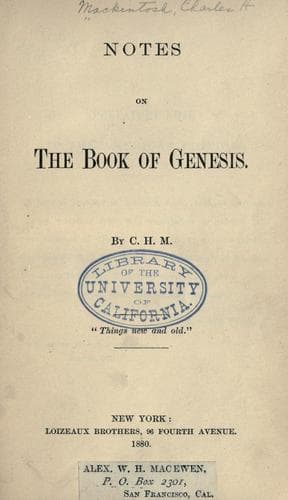
Notes on the Book of GenesisMackintosh, Charles Henry
Religion
Notes on the Book of Genesis
Mackintosh, Charles Henry
Bible. Genesis -- Commentaries
Now, while the birth of Isaac filled Sarah's mouth with laughter, it
introduced an entirely new element into Abraham's house. The son of the
free-woman very speedily developed the true character of the son of the
bond-woman. Indeed, Isaac proved in principle to be to the household of
Abraham what the implantation of the new nature is in the soul of a
sinner. It was not _Ishmael changed_, but it was _Isaac born_. The son
of the bond-woman could never be any thing else but that. He might
become a great nation; he might dwell in the wilderness and become an
archer; he might become the father of twelve princes;--but he was the
son of the bond-woman all the while. On the contrary, no matter how
weak and despised Isaac might be, he was the son of the free-woman. His
position and character, his standing and prospects, were all from the
Lord. "That which is born of the flesh is flesh; and that which is born
of the Spirit is spirit."
Regeneration is not a change of the old nature, but the introduction of
a new: it is the implantation of the nature or life of the second Adam,
by the operation of the Holy Ghost, founded upon the accomplished
redemption of Christ, and in full keeping with the sovereign will or
counsel of God. The moment a sinner believes in his heart and confesses
with his mouth the Lord Jesus, he becomes the possessor of a new life,
and that life is Christ. He is born of God, is a child of God, is a son
of the free-woman. (See Rom. x. 9; Col. iii. 4; 1 John iii. 1, 2; Gal.
iii. 26; iv. 31.)
Nor does the introduction of this new nature alter, in the slightest
degree, the true, essential character of the old. This latter continues
what it was, and is made in no respect better; yea, rather, there is
the full display of its evil character in opposition to the new
element. "The flesh lusteth against the Spirit, and the Spirit against
the flesh; and these are contrary the one to the other." There they are
in all their distinctness, and the one is only thrown into relief by
the other.
Public-domain text, read in full here on John Shaqi.
Reviews
Reviews
No reviews yet
Be the first to share your thoughts on this work.
Elsewhere in the archive
Join the Discussion
Join the discussion
Sign in to leave a comment or review.
Sign InorCreate an account