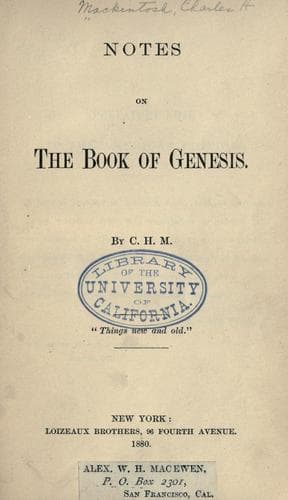
Notes on the Book of GenesisMackintosh, Charles Henry
Religion
Notes on the Book of Genesis
Mackintosh, Charles Henry
Bible. Genesis -- Commentaries
I believe this doctrine of the two natures in the believer is not
generally understood; and yet, so long as there is ignorance of it, the
mind must be utterly at sea, in reference to the true standing and
privileges of the child of God. Some there are, who think that
regeneration is a certain change which the old nature undergoes; and,
moreover, that this change is gradual in its operation, until at length
the whole man becomes transformed. That this idea is unsound can be
proved by various quotations from the New Testament. For example, "the
carnal mind is enmity against God." How can that which is thus spoken
of ever undergo any improvement? The apostle goes on to say, "it is not
subject to the law of God, _neither indeed can be_." If it _cannot be_
subject to the law of God, how can it be improved? How can it undergo
any change? Again, "that which is born of the flesh is flesh." Do what
you will with flesh, and it is flesh all the while. As Solomon says,
"Though thou shouldest bray a fool in a mortar, among wheat with a
pestle, yet will not his foolishness depart from him." (Prov. xxvii.
22.) There is no use in seeking to make foolishness wise: you must
introduce heavenly wisdom into the heart that has been heretofore only
governed by folly. Again, "ye have put off the old man." (Col. iii. 9.)
He does not say, Ye have improved or are seeking to improve "the old
man;" but, Ye have put it off. This gives us a totally different idea.
There is a very great difference between seeking to mend an old
garment, and casting it aside altogether, and putting on a new one.
This is the idea of the last-quoted passage. It is a putting off the
old and a putting on of the new. Nothing can be more distinct or
simple.
Passages might easily be multiplied to prove the unsoundness of the
theory, with respect to the gradual improvement of the old nature,--to
prove that the old nature is dead in sins, and utterly unrenewable and
unimproveable; and, moreover, that the only thing we can do with it is,
to keep it under our feet in the power of that new life which we have
in union with our risen Head in the heavens.
Public-domain text, read in full here on John Shaqi.
Reviews
Reviews
No reviews yet
Be the first to share your thoughts on this work.
Elsewhere in the archive
Join the Discussion
Join the discussion
Sign in to leave a comment or review.
Sign InorCreate an account