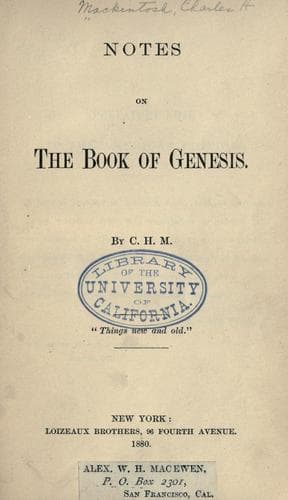
Notes on the Book of GenesisMackintosh, Charles Henry
Religion
Notes on the Book of Genesis
Mackintosh, Charles Henry
Bible. Genesis -- Commentaries
The birth of Isaac did not improve Ishmael, but only brought out his
real opposition to the child of promise. He might have gone on very
quietly and orderly till Isaac made his appearance; but then he showed
what he was by persecuting and mocking at the child of resurrection.
What, then, was the remedy? To make Ishmael better? By no means; but,
"cast out this bond-woman and her son; for the son of this bond-woman
shall not be heir with my son, even with Isaac." (8-10.) Here was the
only remedy. "That which is crooked cannot be made straight;" therefore
you have only to get rid of the crooked thing altogether, and occupy
yourself with that which is divinely straight. It is labor lost to seek
to make a crooked thing straight. Hence all efforts after the
improvement of nature are utterly futile, so far as God is concerned.
It may be all very well for men to cultivate and improve that which is
of use to themselves; but God has given his children something
infinitely better to do, even to cultivate that which is his own
creation, the fruits of which, while they in no wise serve to exalt
nature, are entirely to his praise and glory.
Now, the error into which the Galatian churches fell, was the
introduction of that which addressed itself to nature. "Except ye be
circumcised after the manner of Moses, ye cannot be saved." Here
salvation was made to depend upon something that man could be, or man
could do, or man could keep. This was upsetting the whole glorious
fabric of redemption, which, as the believer knows, rests exclusively
upon what Christ is, and what he has done. To make salvation dependent
in the most remote manner upon any thing in, or done by, man, is to set
it entirely aside. In other words, Ishmael must be entirely cast out,
and all Abraham's hopes be made to depend upon what God had done and
given in the person of Isaac. This, it is needless to say, leaves man
nothing to glory in. If present or future blessedness were made to
depend upon even a divine change wrought in nature, flesh might glory.
Though my nature were improved, it would be something of _me_, and thus
God would not have _all_ the glory. But when I am introduced into a new
creation, I find it is all of God, designed, matured, developed by
himself alone. God is the actor, and I am a worshipper; he is the
blesser, and I am the blessed; he is "the better," and I am "the less;"
(Heb. vii. 7;) he is the giver, and I am the receiver. This is what
makes Christianity what it is; and, moreover, distinguishes it from
every system of human religion under the sun, whether it be Romanism,
Puseyism, or any other _ism_ whatsoever. Human religion gives the
creature a place more or less; it keeps the bond-woman and her son in
the house; it gives man something to glory in. On the contrary,
Christianity excludes the creature from all interference in the work of
salvation; casts out the bond-woman and her son, and gives _all_ the
glory to him to whom alone it is due.
Public-domain text, read in full here on John Shaqi.
Reviews
Reviews
No reviews yet
Be the first to share your thoughts on this work.
Elsewhere in the archive
Join the Discussion
Join the discussion
Sign in to leave a comment or review.
Sign InorCreate an account