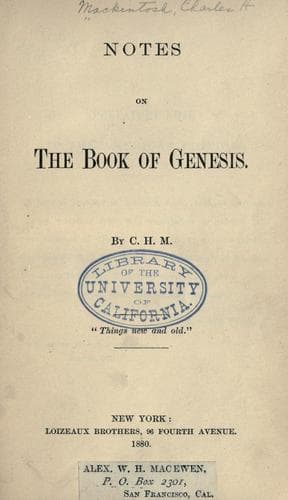
Notes on the Book of GenesisMackintosh, Charles Henry
Religion
Notes on the Book of Genesis
Mackintosh, Charles Henry
Bible. Genesis -- Commentaries
Now, it needs hardly to be remarked that God is glorified in those holy
activities of faith. He is the immediate object of them, as he is the
spring from whence they emanate. There was not a scene in Abraham's
entire history in which God was so much glorified as the scene on Mount
Moriah. There it was that he was enabled to bear testimony to the fact
that he had found all his fresh springs in God,--found them not merely
previous to, but after, Isaac's birth. This is a most touching point.
It is one thing to rest in God's blessings, and another thing to rest
in himself. It is one thing to trust God when I have before my eyes the
channel through which the blessing is to flow; and quite another thing
to trust him when that channel is entirely stopped up. This was what
proved the excellency of Abraham's faith. He showed that he could not
merely trust God for an innumerable seed while Isaac stood before him
in health and vigor; but just as fully if he were a smoking victim on
the altar. This was a high order of confidence in God; it was unalloyed
confidence; it was not a confidence propped up in part by the Creator
and in part by the creature. No; it rested on one solid pedestal, viz.,
God himself. "He accounted that God was able." He never accounted that
Isaac was able. Isaac without God was nothing; God without Isaac was
every thing. This is a principle of the very last importance, and one
eminently calculated to test the heart most keenly. Does it make any
difference to me to see the apparent channel of all my blessings dried
up? Am I dwelling sufficiently near the fountain-head to be able, with
a worshipping spirit, to behold all the creature streams dried up? This
I do feel to be a searching question. Have I such a simple view of
God's sufficiency as to be able as it were to "stretch forth my hand
and take the knife to slay my son." Abraham was enabled to do this,
because his eye rested on the God of resurrection. "He accounted that
God was able to raise him up even from the dead."
In a word, it was with God he had to do, and that was quite enough. He
was not suffered to strike the blow. He had gone to the very utmost
bounds; he had come up to the line beyond which God could not suffer
him to go. The Blessed One spared the father's heart the pang which he
did not spare his own heart, even that of smiting his Son. He, blessed
be his name, passed beyond the utmost bounds, for "he spared not his
own Son, but delivered him up for us all." "It pleased the Lord to
bruise him; he hath put him to grief." There was no voice from heaven
when, on Calvary, the Father offered up his only-begotten Son. No, it
was a perfectly accomplished sacrifice; and in its accomplishment our
everlasting peace is sealed.
Public-domain text, read in full here on John Shaqi.
Reviews
Reviews
No reviews yet
Be the first to share your thoughts on this work.
Elsewhere in the archive
Join the Discussion
Join the discussion
Sign in to leave a comment or review.
Sign InorCreate an account