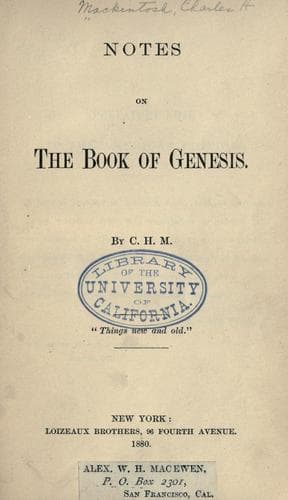
Notes on the Book of GenesisMackintosh, Charles Henry
Religion
Notes on the Book of Genesis
Mackintosh, Charles Henry
Bible. Genesis -- Commentaries
However, Abraham's devotedness was fully proved and fully accepted.
"For now I know that thou fearest God, seeing thou hast not withheld
thy son, thine only son, from me." Mark, it is "_now_ I know." It had
never been proved before. It was there, no doubt; and, if there, God
knew it; but the valuable point here is, that God founds his knowledge
of it upon the palpable evidence afforded at the altar upon Mount
Moriah. Faith is always proved by action, and the fear of God by the
fruits which flow from it. "Was not Abraham our father justified by
works when he had offered Isaac his son on the altar?" (James ii. 21.)
Who could think of calling his faith in question? Take away faith, and
Abraham appears on Moriah as a murderer and a madman. Take faith into
account, and he appears as a devoted worshipper,--a God-fearing,
justified man. But faith must be proved. "What doth it profit, my
brethren, though a man _say_ he hath faith, and have not works?" (James
ii. 14.) Will either God or man be satisfied with a powerless and
profitless profession? Surely not. God looks for reality, and honors it
where he sees it; and as for man, he can understand naught save the
living and intelligible utterance of a faith that shows itself in acts.
We are surrounded by the profession of religion; the phraseology of
faith is on every lip; but faith itself is as rare a gem as ever,--that
faith which will enable a man to push out from the shore of present
circumstances, and meet the waves and the winds, and not only meet
them, but endure them, even though the Master should seem to be asleep
on the pillow.
And here I would remark the beautiful harmony between St. James and St.
Paul on the subject of justification. The intelligent and spiritual
reader, who bows to the important truth of the plenary inspiration of
holy scripture, knows full well that on this question it is not with
Paul or James we have to do, but with the Holy Ghost, who graciously
used each of those honored men as the pen to write his thoughts, just
as I might take up a quill-pen or a steel-pen to write my thoughts, in
which case it would be quite preposterous to speak of a discrepancy
between the two pens, inasmuch as the writer is one. Hence it is just
as impossible that two divinely-inspired penmen could clash, as that
two heavenly bodies, while moving in their divinely-appointed orbits,
could come into collision.
Public-domain text, read in full here on John Shaqi.
Reviews
Reviews
No reviews yet
Be the first to share your thoughts on this work.
Elsewhere in the archive
Join the Discussion
Join the discussion
Sign in to leave a comment or review.
Sign InorCreate an account