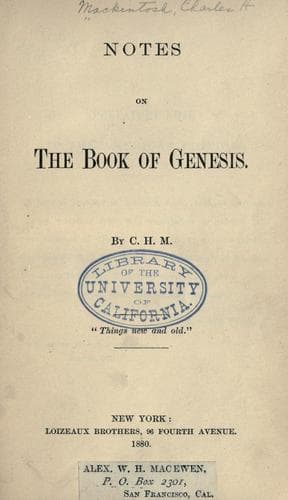
Notes on the Book of GenesisMackintosh, Charles Henry
Religion
Notes on the Book of Genesis
Mackintosh, Charles Henry
Bible. Genesis -- Commentaries
Abraham, because he could swear by no greater, he sware by himself....
For men verily swear by the greater, and an oath for confirmation is to
them an end of all strife. Wherein God, willing more abundantly to show
unto the heirs of promise the immutability of his counsel, confirmed it
by an oath." The word and oath of the living God should put an end to
all the strivings and workings of the human will, and form the
immovable anchor of the soul amid all the tossing and tumult of this
stormy world.
Now, we must condemn ourselves constantly, because of the little power
which the promise of God has in our hearts. There it is, and we profess
to believe it; but ah! it is not that deep, abiding, influential
reality which it ought ever to be; we do not draw from it that "strong
consolation" which it is calculated to afford. How little prepared are
we, in the power of faith, in the promise of God, to slay our Isaac! We
need to cry to God that he would be graciously pleased to endow us
with a deeper insight into the blessed reality of a life of faith in
himself, that so we may understand better the import of that word of
St. John: "This is the victory that overcometh the world, even your
faith." We can only overcome the world by faith. Unbelief puts us under
the power of present things; in other words, it gives the world the
victory over us. A soul that has entered by the teaching of the Holy
Ghost into the sense of God's sufficiency, is entirely independent of
things here. Beloved reader, may we know this, for our peace and joy in
God and his glory in us.
CHAPTER XXIII.
This little section of inspiration furnishes much sweet and profitable
instruction to the soul. In it the Holy Spirit sets before us a
beautiful exhibition of the mode in which the man of faith should carry
himself toward those that are without. While it is true, divinely true,
that faith makes a man independent of the men of the world, it is no
less true that faith will ever teach him to walk honestly toward them.
We are told to "walk honestly toward them that are without;" (1 Thess.
iv. 12:) "to provide things honest in the sight of all;" (2 Cor. viii.
21:) "to owe no man any thing;" (Rom. xiii. 8.) These are weighty
precepts,--precepts which, even before their distinct enunciation, were
duly observed in all ages by the faithful servants of Christ, but which
in modern times alas! have not been sufficiently attended to.
Public-domain text, read in full here on John Shaqi.
Reviews
Reviews
No reviews yet
Be the first to share your thoughts on this work.
Elsewhere in the archive
Join the Discussion
Join the discussion
Sign in to leave a comment or review.
Sign InorCreate an account