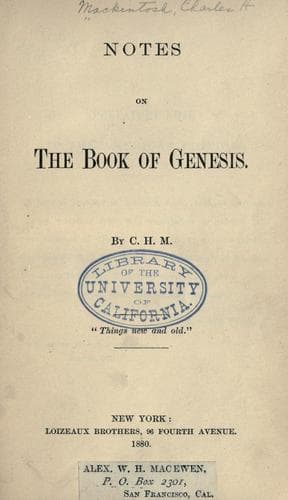
Notes on the Book of GenesisMackintosh, Charles Henry
Religion
Notes on the Book of Genesis
Mackintosh, Charles Henry
Bible. Genesis -- Commentaries
The 23d of Genesis therefore is worthy of special notice. It opens with
the death of Sarah, and introduces Abraham in a new character, viz.,
that of a mourner. "Abraham came to mourn for Sarah, and to weep for
her." The child of God must meet such things; but he must not meet them
as others. The great fact of resurrection comes in to his relief, and
imparts a character to his sorrow quite peculiar. (1 Thess. iv. 13,
14.) The man of faith can stand at the grave of a brother or sister, in
the happy consciousness that it shall not long hold its captive, "For
if we believe that Jesus died and rose again, even so them also which
sleep in Jesus will God bring with him." The redemption of the soul
secures the redemption of the body; the former we have, the latter we
wait for. (Rom. viii. 23.)
Now, I believe that in purchasing Machpelah for a burying-place,
Abraham gave expression to his faith in resurrection. "_He stood up
from_ before his dead." Faith cannot long keep death in view; it has a
higher object, blessed be the "living God" who has given it.
Resurrection is that which ever fills the vision of faith; and, in the
power thereof, it can rise up from before the dead. There is much
conveyed in this action of Abraham. We want to understand its meaning
much more fully, because we are much too prone to be occupied with
death and its consequences. Death is the boundary of Satan's power; but
where Satan ends, God begins. Abraham understood this when he rose up
and purchased the cave of Machpelah as a sleeping-place for Sarah. This
was the expression of Abraham's thought in reference to the future. He
knew that in the ages to come, God's promise about the land of Canaan
would be fulfilled, and he was able to lay the body of Sarah in the
tomb, "in sure and certain hope of a glorious resurrection."
The sons of Heth knew nothing about this. The thoughts which were
filling the patriarch's soul were entirely foreign to the uncircumcised
children of Heth. To them it seemed a small matter where he buried his
dead; but it was by no means a small matter to him. "I am a stranger
and a sojourner with you: give me a possession of a burying-place with
you that I may bury my dead out of my sight." It might, and manifestly
did, appear strange to them to make so much ado about a grave; but,
"beloved, the world knoweth us not, even as it knew him not." The
finest traits and characteristics of faith are those which are most
incomprehensible to the natural man. The Canaanites had no idea of the
expectations which were giving character to Abraham's actings on this
occasion. They had no idea that he was looking forward to the
possession of the land, while he was merely looking for a spot in
which, as a dead man, he might wait for God's time, and God's manner,
viz., the MORNING OF RESURRECTION. He felt _he_ had no controversy with
the children of Heth, and hence he was quite prepared to lay his head
in the grave, and allow God to act for him, and with him, and by him.
Public-domain text, read in full here on John Shaqi.
Reviews
Reviews
No reviews yet
Be the first to share your thoughts on this work.
Elsewhere in the archive
Join the Discussion
Join the discussion
Sign in to leave a comment or review.
Sign InorCreate an account