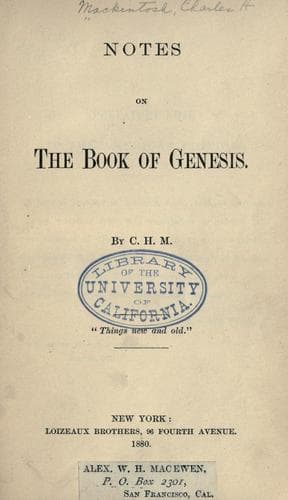
Notes on the Book of GenesisMackintosh, Charles Henry
Religion
Notes on the Book of Genesis
Mackintosh, Charles Henry
Bible. Genesis -- Commentaries
Thus it was with Abraham, in reference to the sons of Heth. His whole
deportment and conduct, as set forth in our chapter, would seem to have
been marked with very pure elevation and disinterestedness. He was "a
mighty prince among them," and they would fain have done him a favor;
but Abraham had learnt to take his favors only from the God of
resurrection, and while he would pay _them_ for Machpelah, he would
look to _him_ for Canaan. The sons of Heth knew well the value of
"current money with the merchant," and Abraham knew the value of the
cave of Machpelah. It was worth much more to him than it was to them.
"The land was worth" to them "four hundred shekels of silver," but to
him it was priceless, as the earnest of an everlasting inheritance,
which, because it was an everlasting inheritance, could only be
possessed in the power of resurrection. Faith conducts the soul onward
into God's future; it looks at things as he looks at them, and
estimates them according to the judgment of the sanctuary. Therefore,
in the intelligence of faith, Abraham stood up from before his dead,
and purchased a burying-place, which significantly set forth his hope
of resurrection, and of an inheritance founded thereon.
CHAPTER XXIV.
The connection of this chapter with the two which precede it is worthy
of notice. In Chapter xxii. the son is offered up; in Chap. xxiii.
Sarah is laid aside; and in Chapter xxiv. the servant is sent forth to
procure a bride for him who had been, as it were, received from the
dead in a figure. This connection, in a very striking manner, coincides
with the order of events connected with the calling out of the Church.
Whether this coincidence is to be regarded as of divine origin will, it
may be, raise a question in the minds of some; but it must at least be
regarded as not a little remarkable.
When we turn to the New Testament, the grand events which meet our view
are, first, the rejection and death of Christ; secondly, the setting
aside of Israel after the flesh; and, lastly, the calling out of the
Church to occupy the high position of the bride of the Lamb.
Now all this exactly corresponds with the contents of this and the two
preceding chapters. The death of Christ needed to be an accomplished
fact ere the Church, properly so called, could be called out. "The
middle wall of partition" needed to be broken down, ere the "_one new
man_" could be developed. It is well to understand this in order that
we may know the place which the Church occupies in the ways of God. So
long as the Jewish economy subsisted there was the most strict
separation maintained between Jew and Gentile, and hence the idea of
both being united in one new man was far removed from the mind of a
Jew. He was led to view himself in a position of entire superiority to
that of a Gentile, and to view the latter as utterly unclean, to whom
it was unlawful to come in. (Acts x. 28.)
Public-domain text, read in full here on John Shaqi.
Reviews
Reviews
No reviews yet
Be the first to share your thoughts on this work.
Elsewhere in the archive
Join the Discussion
Join the discussion
Sign in to leave a comment or review.
Sign InorCreate an account