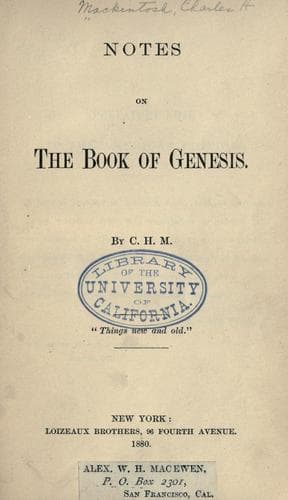
Notes on the Book of GenesisMackintosh, Charles Henry
Religion
Notes on the Book of Genesis
Mackintosh, Charles Henry
Bible. Genesis -- Commentaries
If Israel had walked with God according to the truth of the
relationship into which he had graciously brought them, they would have
continued in their peculiar place of separation and superiority; but
this they did not do; and, therefore, when they had filled up the
measure of their iniquity, by crucifying the Lord of life and glory,
and rejecting the testimony of the Holy Ghost, we find St. Paul is
raised up to be the minister of a new thing, which was held back in the
counsels of God, while the testimony to Israel was going on. "For this
cause I, Paul, the prisoner of Jesus Christ for you Gentiles, if ye
have heard of the dispensation of the grace of God, which is given me
to you-ward: how that by revelation he made known unto me the mystery
... which in other ages was not made known unto the sons of men, _as it
is now_ revealed unto his holy apostles and prophets (i. e.,
New-Testament prophets, [Greek: tois hagiois apostolois autou kai
prophetais]) by the Spirit; that the Gentiles should be fellow-heirs,
and of the same body, and partakers of his promise in Christ by the
gospel." (Eph. iii. 1-6.) This is conclusive. The mystery of the
Church, composed of Jew and Gentile, baptized by one Spirit into one
body, united to the glorious Head in the heavens, had never been
revealed until Paul's day. Of this mystery the apostle goes on to say,
"_I_ was made a minister, according to the gift of the grace of God,
given unto me, by the effectual working of his power." (Ver. 7.) The
apostles and prophets of the New Testament formed, as it were, the
first layer of this glorious building. (See Eph. ii. 20.) This being
so, it follows as a consequence that the building could not have been
begun before. If the building had been going on from the days of Abel
downwards, the apostle would then have said, "the foundation of the
Old-Testament saints." But he has not said so, and therefore we
conclude that, whatever be the position assigned to the Old-Testament
saints, they cannot possibly belong to a body which had no existence,
save in the purpose of God, until the death and resurrection of Christ,
and the consequent descent of the Holy Ghost. Saved they were, blessed
be God: saved by the blood of Christ, and destined to enjoy heavenly
glory with the Church; but they could not have formed a part of that
which did not exist for hundreds of years after their time.
It were easy to enter upon a more elaborate demonstration of this most
important truth, were this the place for so doing; but I shall now go
on with our chapter, having merely touched upon a question of
commanding interest, because of its being suggested by the position of
the 24th of Genesis.
Public-domain text, read in full here on John Shaqi.
Reviews
Reviews
No reviews yet
Be the first to share your thoughts on this work.
Elsewhere in the archive
Join the Discussion
Join the discussion
Sign in to leave a comment or review.
Sign InorCreate an account