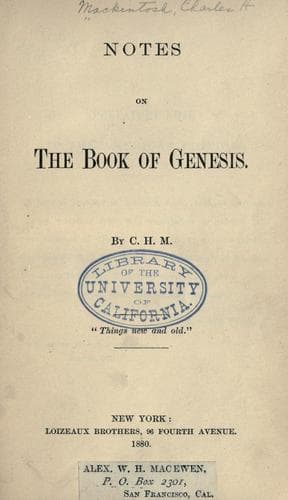
Notes on the Book of GenesisMackintosh, Charles Henry
Religion
Notes on the Book of Genesis
Mackintosh, Charles Henry
Bible. Genesis -- Commentaries
There is a passage in Chap. xxv. which I purposely passed over, in
order to take it up here, so that we might have the truth in reference
to Jacob fully before us. "And Isaac entreated the Lord for his wife,
because she was barren; and the Lord was entreated of him, and Rebekah
his wife conceived. And the children struggled together within her: and
she said, If it be so, why am I thus? And she went to inquire of the
Lord. And the Lord said unto her, Two nations are in thy womb, and two
manner of people shall be separated from thy bowels; and the one people
shall be stronger than the other people; and the elder shall serve the
younger." This is referred to in Malachi, where we read, "I have loved
you, saith the Lord; yet ye say, wherein hast thou loved us? Was not
Esau Jacob's brother? saith the Lord: yet I have loved Jacob and hated
Esau." This is again referred to in Rom. ix.: "For the children being
not yet born, neither having done any good or evil, that the purpose of
God according to election might stand, not of works, but of him that
calleth; it was said unto her, The elder shall serve the younger, as it
is written, Jacob have I loved, but Esau have I hated."
Thus we have very distinctly before us, God's eternal purpose according
to _the election of grace_. There is much involved in this expression.
It banishes all human pretension from the scene, and asserts God's
right to act as he will. This is of the very last importance. The
creature can enjoy no real blessedness until he is brought to bow his
head to sovereign grace. It becomes him so to do, inasmuch as he is a
sinner, and as such utterly without claim to act or dictate. The great
value of finding oneself on this ground is, that it is then no longer a
question of what we deserve to get, but simply of what God is pleased
to give. The prodigal might talk of being a servant, but he really did
not deserve the place of a servant, if it were to be made a question of
desert; and therefore he had only to take what the father was pleased
to give,--and that was the very highest place, even the place of
fellowship with himself. Thus it must ever be. "Grace all the work
shall crown through everlasting days." Happy for us that it is so. As
we go on, day by day, making fresh discoveries of ourselves, we need to
have beneath our feet the solid foundation of God's grace: nothing else
could possibly sustain us in our growing self-knowledge. The ruin is
hopeless, and therefore the grace must be infinite: and infinite it is,
having its source in God himself, its channel in Christ, and the power
of application and enjoyment in the Holy Ghost. The Trinity is brought
out in connection with the grace that saves a poor sinner. "Grace
reigns through righteousness, unto eternal life, by Jesus Christ our
Lord." It is only in redemption that this reign of grace could be seen.
We may see in creation the reign of wisdom and power; we may see in
providence the reign of goodness and long-suffering; but only in
Public-domain text, read in full here on John Shaqi.
Reviews
Reviews
No reviews yet
Be the first to share your thoughts on this work.
Elsewhere in the archive
Join the Discussion
Join the discussion
Sign in to leave a comment or review.
Sign InorCreate an account