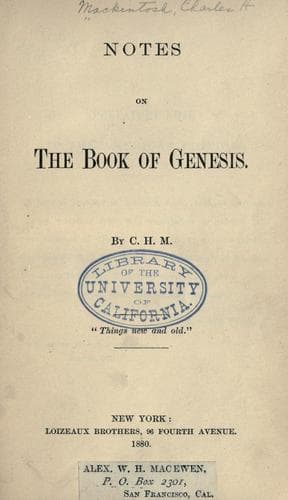
Notes on the Book of GenesisMackintosh, Charles Henry
Religion
Notes on the Book of Genesis
Mackintosh, Charles Henry
Bible. Genesis -- Commentaries
redemption do we see the reign of grace, and that, too, on the
principle of righteousness.
Now, we have in the person of Jacob a most striking exhibition of the
power of divine grace; and for this reason, that we have in him a
striking exhibition of the power of human nature. In him we see nature
in all its obliquity, and therefore we see grace in all its moral
beauty and power. From the facts of his remarkable history, it would
seem that, before his birth, at his birth, and after his birth, the
extraordinary energy of nature was seen. Before his birth, we read,
"the children struggled together within her." At his birth, we read,
"his hand took hold on Esau's heel." And, after his birth,--yea, to the
turning-point of his history, in Chap. xxxii., without any
exception,--his course exhibits nothing but the most unamiable traits
of nature; but all this only serves, like a dark back-ground, to throw
into relief the grace of him who condescends to call himself by the
peculiarly touching name, "the God of Jacob,"--a name most sweetly
expressive of free grace.
Let us now examine the chapters consecutively. Chap. xxvii. exhibits a
most humbling picture of sensuality, deceit, and cunning; and when one
thinks of such things in connection with the people of God, it is sad
and painful to the very last degree. Yet how true and faithful is the
Holy Ghost! He must tell all out. He cannot give us a partial picture.
If he gives us a history of man, he must describe man as he is, and not
as he is not.
So, if he unfolds to us the character and ways of God, he gives us God
as he is. And this, we need hardly remark, is exactly what we need. We
need the revelation of one perfect in holiness, yet perfect in grace
and mercy, who could come down into all the depth of man's need, his
misery and his degradation, and deal with him there, and raise him up
out of it into full, unhindered fellowship with himself in all the
reality of what he is. This is what scripture gives us. God knew what
we needed, and he has given it to us, blessed be his name!
And be it remembered that in setting before us in faithful love all the
traits of a man's character, it is simply with a view to magnify the
riches of divine grace and to admonish our souls. It is not by any
means in order to perpetuate the memory of sins forever blotted out
from his sight. The blots, the failures, and the errors of Abraham,
Isaac, and Jacob, have been perfectly washed away, and they have taken
their place amid "the spirits of just men made perfect;" but their
history remains on the page of inspiration for the display of God's
grace, and for the warning of God's people in all ages; and, moreover,
that we may distinctly see that the blessed God has not been dealing
with perfect men and women, but with those of "like passions as we
are;" that he has been walking and bearing with the same failures, the
same infirmities, the same errors, as those over which we mourn every
day.
Public-domain text, read in full here on John Shaqi.
Reviews
Reviews
No reviews yet
Be the first to share your thoughts on this work.
Elsewhere in the archive
Join the Discussion
Join the discussion
Sign in to leave a comment or review.
Sign InorCreate an account