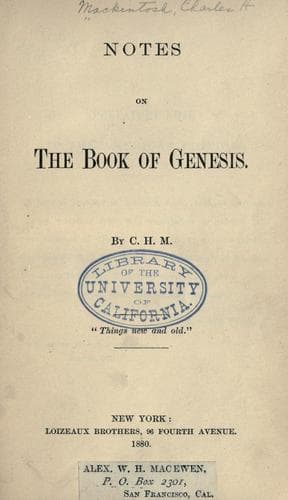
Notes on the Book of GenesisMackintosh, Charles Henry
Religion
Notes on the Book of Genesis
Mackintosh, Charles Henry
Bible. Genesis -- Commentaries
This is peculiarly comforting to the heart; and it may well stand in
striking contrast with the way in which the great majority of human
biographies are written, in which, for the most part, we find not the
history of men, but of beings devoid of error and infirmity. Such
histories have rather the effect of discouraging than of edifying those
who read them. They are rather histories of what men ought to be, than
of what they really are, and they are therefore useless to us,--yea,
not only useless, but mischievous.
Nothing can edify save the presentation of God dealing with man as he
really is; and this is what the word gives us. The chapter before us
illustrates this very fully. Here we find the aged patriarch Isaac,
standing as it were at the very portal of eternity, the earth and
nature fast fading away from his view, yet occupied about "savory
meat," and about to act in direct opposition to the divine counsel, by
blessing the elder instead of the younger. Truly this was nature, and
nature with its "eyes dim." If Esau had sold his birthright for a mess
of pottage, Isaac was about to give away the blessing for a mess of
venison. How very humiliating!
But God's purpose must stand, and he will do all his pleasure. Faith
knows this; and, in the power of that knowledge, can wait for God's
time. This nature never can do, but must set about gaining its own ends
by its own inventions. These are the two grand points brought out in
Jacob's history,--God's purpose of grace on the one hand; and, on the
other, nature plotting and scheming to reach what that purpose would
have infallibly brought about without any plot or scheme at all. This
simplifies Jacob's history amazingly, and not only simplifies it, but
heightens the soul's interest in it also. There is nothing, perhaps, in
which we are so lamentably deficient, as in the grace of patient,
self-renouncing dependence upon God. Nature will be working in some
shape or form, and thus, so far as in it lies, hindering the outshining
of divine grace and power. God did not need the aid of such elements as
Rebekah's cunning and Jacob's gross deceit, in order to accomplish his
purpose. He had said, "the elder shall serve the younger." This was
enough,--enough for faith, but not enough for nature, which must ever
adopt its own ways, and know nothing of what it is to wait on God.
Public-domain text, read in full here on John Shaqi.
Reviews
Reviews
No reviews yet
Be the first to share your thoughts on this work.
Elsewhere in the archive
Join the Discussion
Join the discussion
Sign in to leave a comment or review.
Sign InorCreate an account