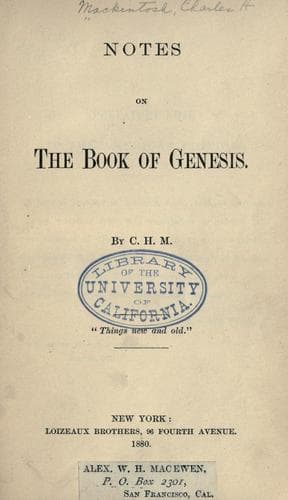
Notes on the Book of GenesisMackintosh, Charles Henry
Religion
Notes on the Book of Genesis
Mackintosh, Charles Henry
Bible. Genesis -- Commentaries
The prophet Hosea leads us on to the time when that which was
foreshadowed by Jacob's ladder shall have its full accomplishment. "And
in that day I will make a covenant for them with the beasts of the
field, and with the fowls of heaven, and with the creeping things of
the ground: and I will break the bow, and the sword, and the battle,
out of the earth, and will make them to lie down safely. And I will
betroth thee unto me forever; yea, I will betroth thee unto me in
righteousness, and in judgment, and in loving-kindness, and in mercies;
I will even betroth thee unto me in faithfulness; and thou shalt know
the Lord. And it shall come to pass in that day, I will hear, saith the
Lord, I will hear the heavens, and they shall hear the earth; and the
earth shall hear the corn, and the wine, and the oil; and they shall
hear Jezreel. And I will sow her unto me in the earth; and I will have
mercy upon her that had not obtained mercy; and I will say to them
which were not my people, Thou art my people; and they shall say, Thou
art my God." (Hosea ii. 18-23.) There is also an expression in the
first chapter of John, bearing upon Jacob's remarkable vision; it is
Christ's word to Nathanael, "Verily, verily, I say unto you, hereafter
ye shall see heaven open, and the angels of God ascending and
descending upon the Son of man." (Ver. 51.)
Now, this vision of Jacob's is a very blessed disclosure of divine
grace to Israel. We have been led to see something of Jacob's real
character, something, too, of his real condition; both were evidently
such as to show that it should either be divine grace for him, or
nothing. By birth he had no claim; nor yet by character. Esau might put
forward some claim on both these grounds; i. e., provided God's
prerogative were set aside; but Jacob had no claim whatsoever; and
hence, while Esau could only stand upon the exclusion of God's
prerogative, Jacob could only stand upon the introduction and
establishment thereof. Jacob was such a sinner, and so utterly divested
of all claim, both by birth and by practice, that he had nothing
whatever to rest upon save God's purpose of pure, free, and sovereign
grace. Hence, in the revelation which the Lord makes to his chosen
servant, in the passage just quoted, it is a simple record or
prediction of what he himself would yet do. "_I_ am.... _I_ will
give.... _I_ will keep.... _I_ will bring.... _I_ will not leave thee
until _I_ have done that which _I_ have spoken to thee of." It was all
himself. There is no condition whatever. No _if_ or _but_; for when
_grace_ acts there can be no such thing. Where there is an _if_, it
cannot possibly be grace. Not that God cannot put man into a position
of responsibility in which he must needs address him with an "if." We
know he can; but Jacob asleep on a pillow of stone was not in a
position of responsibility, but of the deepest helplessness and need;
and therefore he was in a position to receive a revelation of the
Public-domain text, read in full here on John Shaqi.
Reviews
Reviews
No reviews yet
Be the first to share your thoughts on this work.
Elsewhere in the archive
Join the Discussion
Join the discussion
Sign in to leave a comment or review.
Sign InorCreate an account