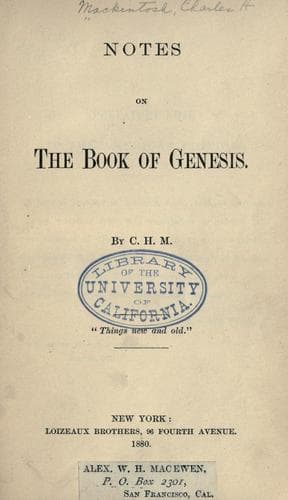
Notes on the Book of GenesisMackintosh, Charles Henry
Religion
Notes on the Book of Genesis
Mackintosh, Charles Henry
Bible. Genesis -- Commentaries
fullest, richest, and most unconditional grace.
Now, we cannot but own the blessedness of being in such a condition
that we have nothing to rest upon save God himself; and, moreover, that
it is in the most perfect establishment of God's own character and
prerogative that we obtain all our true joy and blessing. According to
this principle, it would be an irreparable loss to us to have any
ground of our own to stand upon, for in that case God should address us
on the ground of responsibility, and failure would then be inevitable.
Jacob was so bad, that none but God himself could do for him.
And, be it remarked, that it was his failure in the habitual
recognition of this that led him into so much sorrow and pressure.
God's revelation of himself is one thing, and our resting in that
revelation is quite another. God shows himself to Jacob, in infinite
grace; but no sooner does Jacob awake out of sleep, than we find him
developing his true character, and proving how little he knew,
practically, of the blessed One who had just been revealing himself so
marvellously to him. "He was afraid, and said, How dreadful is this
place! This is none other but the house of God, and this is the gate of
heaven." His heart was not at home in the presence of God; nor can any
heart be so until it has been thoroughly emptied and broken. God is at
home, blessed be his name, with a broken heart, and a broken heart at
home with him. But Jacob's heart was not yet in this condition; nor had
he yet learnt to repose, like a little child, in the perfect love of
one who could say, "Jacob have I loved." "Perfect love casteth out
fear;" but where such love is not known and fully realized, there will
always be a measure of uneasiness and perturbation. God's house and
God's presence are not dreadful to a soul who knows the love of God as
expressed in the perfect sacrifice of Christ. Such a soul is rather led
to say, "Lord, I have loved the habitation of thy house, and the place
where thine honor dwelleth." (Ps. xxvi. 8.) And again, "One thing have
I desired of the Lord, that will I seek after; that I may dwell in the
house of the Lord all the days of my life, to behold the beauty of the
Lord, and to inquire in his temple." (Ps. xxvii. 4.) And again, "How
amiable are thy tabernacles, O Lord of hosts! My soul longeth, yea,
even fainteth, for the courts of the Lord." (Ps. lxxxiv.) When the
heart is established in the knowledge of God, it will assuredly love
his house, whatever the character of that house may be, whether it be
Bethel, or the temple at Jerusalem, or the Church now composed of all
true believers, "builded together for an habitation of God through the
Spirit." However, Jacob's knowledge, both of God and his house, was
very shallow, at that point in his history on which we are now
dwelling.
Public-domain text, read in full here on John Shaqi.
Reviews
Reviews
No reviews yet
Be the first to share your thoughts on this work.
Elsewhere in the archive
Join the Discussion
Join the discussion
Sign in to leave a comment or review.
Sign InorCreate an account