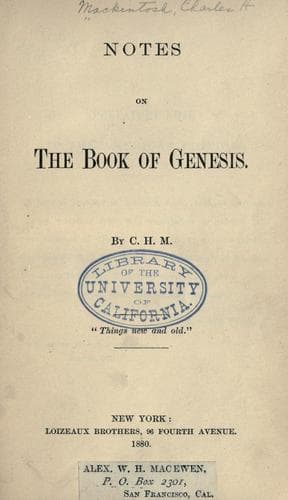
Notes on the Book of GenesisMackintosh, Charles Henry
Religion
Notes on the Book of Genesis
Mackintosh, Charles Henry
Bible. Genesis -- Commentaries
Many there are who at first fail in the full apprehension of the utter
ruin of nature as looked at in God's presence, though their hearts have
been attracted by the grace of God, and their consciences tranquillized
in some degree by the application of the blood of Christ. Hence, as
they get on in their course, they begin to make deeper discoveries of
the evil within; and, being deficient in their apprehensions of God's
grace and the extent and efficacy of the sacrifice of Christ, they
immediately raise a question as to their being children of God at all.
Thus they are taken off Christ and thrown on themselves, and then they
either betake themselves to ordinances in order to keep up their tone
of devotion, or else fall back into thorough worldliness and carnality.
These are disastrous consequences, and all the result of not having
"the heart established in grace."
It is this that renders the study of Jacob's history so profoundly
interesting and eminently useful. No one can read the three chapters
now before us and not be struck at the amazing grace that could take up
such an one as Jacob; and not only take him up, but say, after the full
discovery of all that was in him, "He hath not beheld iniquity in
Jacob, neither hath he seen perverseness in Israel." (Numb. xxiii. 21.)
He does not say that iniquity and perverseness were not in him. This
would never give the heart confidence,--the very thing above all others
which God desires to give. It could never assure a poor sinner's heart
to be told that there was _no sin in_ him; for alas! he knows too well
there is; but to be told there is no sin _on_ him, and that, moreover,
in God's sight, on the simple ground of Christ's perfect sacrifice,
must infallibly set his heart and conscience at rest. Had God taken up
Esau, we should not have had by any means such a blessed display of
grace; for this reason, that he does not appear before us in the
unamiable light in which we see Jacob. The more man sinks, the more
God's grace rises. As my debt rises in my estimation from the fifty
pence up to the five hundred, so my sense of grace rises also, my
experience of that love which, when we "had _nothing_ to pay," could
"frankly forgive" us all. (Luke vii. 42.) Well might the apostle say,
"it is a good thing that the heart be established with grace: not with
meats, which have not profited them that have been occupied therein."
(Heb. xiii. 9.)
FOOTNOTES:
[18] It is deeply interesting to the spiritual mind to mark how
sedulously the Spirit of God, in Rom. ix. and indeed throughout all
scripture, guards against the horrid inference which the human mind
draws from the doctrine of God's election. When he speaks of "vessels
of wrath," he simply says, "fitted to destruction." He does not say
that God "fitted" them.
Whereas, on the other hand, when he refers to "the vessels of mercy" he
says, "whom _he_ had afore prepared unto glory." This is most marked.
Public-domain text, read in full here on John Shaqi.
Reviews
Reviews
No reviews yet
Be the first to share your thoughts on this work.
Elsewhere in the archive
Join the Discussion
Join the discussion
Sign in to leave a comment or review.
Sign InorCreate an account