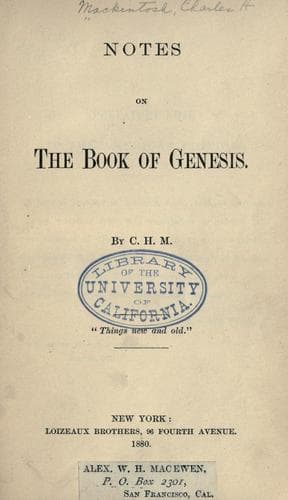
Notes on the Book of GenesisMackintosh, Charles Henry
Religion
Notes on the Book of Genesis
Mackintosh, Charles Henry
Bible. Genesis -- Commentaries
If my reader will turn for a moment to Matt. xxv. 34-41, he will find
another striking and beautiful instance of the same thing.
When the king addresses those on his right hand, he says, "Come, ye
_blessed of my Father_, inherit the kingdom _prepared for you_ from the
foundation of the world." (Verse 34.)
But when he addresses those on his left, he says, "Depart from me, ye
cursed." He does not say, "cursed of my Father." And, further, he says,
"into everlasting fire, prepared," not for _you_, but "for the devil
and his angels." (Verse 41.)
In a word, then, it is plain that God has "prepared" a kingdom of
glory, and "vessels of mercy" to inherit that kingdom; but he has not
prepared "everlasting fire" for men, but for the "devil and his
angels;" nor has he fitted the "vessels of wrath," but they have fitted
themselves.
The word of God as clearly establishes "_election_" as it sedulously
guards against "_reprobation_." Every one who finds himself in heaven
will have to thank God for it; and every one that finds himself in hell
will have to thank himself.
CHAPTER XXXII.
"And Jacob went on his way, and the angels of God met him." Still God's
grace follows him, notwithstanding all. "Nothing changeth God's
affection." Whom he loves, and how he loves, he loves to the end. His
love is like himself, "the same yesterday, to-day, and forever." But
how little effect "God's host" had upon Jacob may be seen by his
actings as here set before us. "And Jacob sent messengers before him to
Esau his brother, unto the land of Seir, the country of Edom." He
evidently feels uneasy in reference to Esau, and not without reason. He
had treated him badly, and his conscience was not at ease; but instead
of casting himself unreservedly upon God, he betakes himself to his
usual planning again, in order to avert Esau's wrath. He tries to
_manage_ Esau, instead of leaning on God.
"And he commanded them, saying, Thus shall ye speak unto _my lord_
Esau; _thy servant_ Jacob saith thus, I have sojourned with Laban, and
stayed there until now." All this bespeaks a soul very much off its
centre in God. "My lord," and "thy servant," is not like the language
of a brother, or of one in the conscious dignity of the presence of
God; but it was the language of Jacob, and of Jacob, too, with a bad
conscience.
Public-domain text, read in full here on John Shaqi.
Reviews
Reviews
No reviews yet
Be the first to share your thoughts on this work.
Elsewhere in the archive
Join the Discussion
Join the discussion
Sign in to leave a comment or review.
Sign InorCreate an account