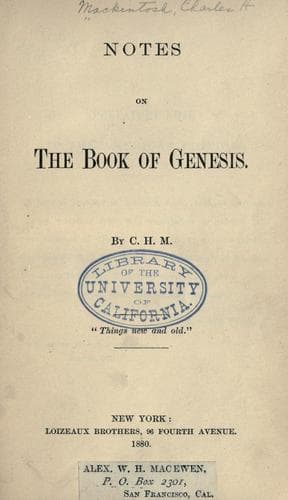
Notes on the Book of GenesisMackintosh, Charles Henry
Religion
Notes on the Book of Genesis
Mackintosh, Charles Henry
Bible. Genesis -- Commentaries
Nor will it do to make our prayers part of our management. We often
feel very well satisfied with ourselves when we add prayer to our
arrangement, or when we have used all lawful means and called upon God
to bless them. When this is the case, our prayers are worth about as
much as our plans, inasmuch as we are leaning upon them instead of upon
God. We must be really brought to the end of every thing with which
self has aught to do; for until then, God cannot show himself. But we
can never get to the end of our plans until we have been brought to the
end of ourselves. We must see that "all flesh is grass, and all the
goodliness thereof is as the flower of the field." (Isa. xl. 6.)
Thus it is in this interesting chapter; when Jacob had made all his
prudent arrangements, we read, "And Jacob was left alone; and there
wrestled a man with him until the breaking of the day." This is a
turning-point in the history of this very remarkable man. To be left
alone with God is the only true way of arriving at a just knowledge of
ourselves and our ways. We can never get a true estimate of nature and
all its actings, until we have weighed them in the balance of the
sanctuary, and there we ascertain their real worth. No matter what we
may think about ourselves, nor yet what man may think about us; the
great question is, What does God think about us? And the answer to this
question can only be heard when we are "left alone." Away from the
world; away from self; away from all the thoughts, reasonings,
imaginations, and emotions of mere nature, and "alone" with God,--thus,
and thus alone, can we get a correct judgment about ourselves.
"Jacob was left alone; and there wrestled a man with him." Mark, it was
not Jacob wrestling with a man; but a man wrestling with Jacob; this
scene is very commonly referred to as an instance of Jacob's power in
prayer. That it is not this is evident from the simple wording of the
passage. My wrestling with a man, and a man wrestling with me, present
two totally different ideas to the mind. In the former case I want to
gain some object from him; in the latter, he wants to gain some object
from me. Now, in Jacob's case, the divine object was to bring him to
see what a poor, feeble, worthless creature he was, and when Jacob so
pertinaciously held out against the divine dealing with him, "he
touched the hollow of his thigh; and the hollow of Jacob's thigh was
out of joint as he wrestled with him." The sentence of death must be
written on the flesh,--the power of the cross must be entered into
before we can steadily and happily walk with God. We have followed
Jacob so far, amid all the windings and workings of his extraordinary
character,--we have seen him planning and managing during his twenty
years' sojourn with Laban; but not until he "was left alone," did he
get a true idea of what a perfectly helpless thing he was in himself.
Then, the seat of his strength being touched, he learnt to say, "I will
not let _thee_ go."
Public-domain text, read in full here on John Shaqi.
Reviews
Reviews
No reviews yet
Be the first to share your thoughts on this work.
Elsewhere in the archive
Join the Discussion
Join the discussion
Sign in to leave a comment or review.
Sign InorCreate an account