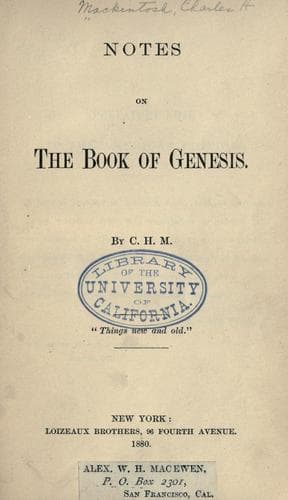
Notes on the Book of GenesisMackintosh, Charles Henry
Religion
Notes on the Book of Genesis
Mackintosh, Charles Henry
Bible. Genesis -- Commentaries
"Other refuge have I none:
Clings my helpless soul to thee."
This was a new era in the history of the supplanting, planning Jacob.
Up to this point he had held fast by his own ways and means; but now he
is brought to say, "I will not let _thee_ go." Now, let my reader
remark, that Jacob did not express himself thus until "the hollow of
his thigh was touched." This simple fact is quite sufficient to settle
the true interpretation of the whole scene. God was wrestling with
Jacob to bring him to this point. We have already seen that, as to
Jacob's power in prayer, he had no sooner uttered a few words to God
than he let out the real secret of his soul's dependence, by saying, "I
will appease him (Esau) with a present." Would he have said this if he
had really entered into the meaning of prayer, or true dependence upon
God? Assuredly not. If he had been looking to God alone to appease
Esau, could he have said, "I will appease him by a present?"
Impossible: God and the creature must be kept distinct, and will be
kept so in every soul that knows much of the sacred reality of a life
of faith.
But, alas! here is where we fail, if one may speak for another. Under
the plausible and apparently pious formula of using means, we really
cloak the positive infidelity of our poor deceitful hearts; we think we
are looking to God to bless our means, while, in reality, we are
shutting him out by leaning on the means, instead of leaning on him.
Oh, may our hearts be taught the evil of thus acting. May we learn to
cling more simply to God _alone_, that so our history may be more
characterized by that holy elevation above the circumstances through
which we are passing! It is not, by any means, an easy matter so to get
to the end of the creature, in every shape and form, as to be able to
say, "I will not let thee go except thou bless me." To say this from
the heart, and to abide in the power of it, is the secret of all true
strength. Jacob said it when the hollow of his thigh was touched; but
not till then. He struggled long ere he gave way, because his
confidence in the flesh was strong. But God can bring down to the dust
the stoutest character. He knows how to touch the spring of nature's
strength, and write the sentence of death thoroughly upon it; and until
this is done, there can be no real "power with God or man." We must be
"weak" ere we can be "strong." "The power of Christ" can only "rest on
us" in connection with the knowledge of our infirmities. Christ cannot
put the seal of his approval upon nature's strength, its wisdom, or its
glory: all these must sink that he may rise. Nature can never form, in
any one way, a pedestal on which to display the grace or power of
Christ; for if it could, then might flesh glory in his presence; but
this, we know, can never be.
Public-domain text, read in full here on John Shaqi.
Reviews
Reviews
No reviews yet
Be the first to share your thoughts on this work.
Elsewhere in the archive
Join the Discussion
Join the discussion
Sign in to leave a comment or review.
Sign InorCreate an account