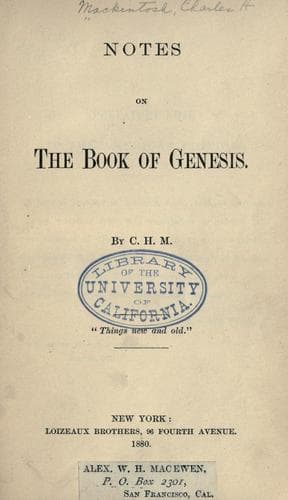
Notes on the Book of GenesisMackintosh, Charles Henry
Religion
Notes on the Book of Genesis
Mackintosh, Charles Henry
Bible. Genesis -- Commentaries
And, inasmuch as the display of God's glory, and God's name or
character, is connected with the entire setting aside of nature, so,
until this latter is set aside, the soul can never enjoy the disclosure
of the former. Hence, though Jacob is called to tell out his name, to
own that his name is "Jacob, or a supplanter," he yet receives no
revelation of the name of him who had been wrestling with him, and
bringing him down into the dust. He received for himself the name of
"Israel, or prince," which was a great step in advance; but when he
says, "Tell me, I pray thee, thy name;" he received the reply,
"Wherefore is it that thou dost ask after my name?" The Lord refuses to
tell his name, though he had elicited from Jacob the truth as to
himself, and he blesses him accordingly. How often is this the case in
the annals of God's family! There is the disclosure of self in all its
moral deformity; but we fail to get hold practically of what God is,
though he has come so very close to us, and blessed us, too, in
connection with the discovery of ourselves. Jacob received the new name
of Israel when the hollow of his thigh had been touched. He became a
mighty prince when he had been brought to know himself as a weak man;
but still the Lord had to say, "Wherefore is it that thou dost ask
after my name?" There is no disclosure of the name of him who,
nevertheless, had brought out the real name and condition of Jacob.
From all this we learn that it is one thing to be blessed by the Lord,
and quite another thing to have the revelation of his character, by the
Spirit, to our hearts. "He blessed him there;" but he did not tell his
name. There is blessing in being brought, in any measure, to know
ourselves, for therein we are led into a path, in which we are able,
more clearly, to discern what God is to us in detail. Thus it was with
Jacob. When the hollow of his thigh was touched he found himself in a
condition in which it was either God or nothing. A poor halting man
could do little: it therefore behoved him to cling to one who was
almighty.
Public-domain text, read in full here on John Shaqi.
Reviews
Reviews
No reviews yet
Be the first to share your thoughts on this work.
Elsewhere in the archive
Join the Discussion
Join the discussion
Sign in to leave a comment or review.
Sign InorCreate an account