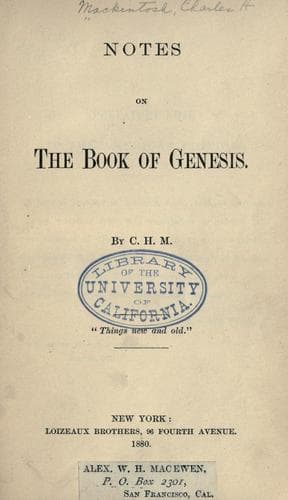
Notes on the Book of GenesisMackintosh, Charles Henry
Religion
Notes on the Book of Genesis
Mackintosh, Charles Henry
Bible. Genesis -- Commentaries
We shall see, when we come to Chap. xxxv. that Jacob is led to take a
higher and a wider view of God; but at Shechem he was manifestly on low
ground, and he was made to smart for it, as is always the case when we
stop short of God's own ground. The two tribes and a half took up their
position on this side of Jordan, and they were the first to fall into
the enemy's hand. So it was with Jacob. We see, in Chap. xxxiv., the
bitter fruits of his sojourn at Shechem. There is a blot cast upon his
family, which Simeon and Levi attempt to wipe out, in the mere energy
and violence of nature, which only led to still deeper sorrow; and
that, too, which touched Jacob still more keenly than the insult
offered to his daughter: "And Jacob said to Simeon and Levi, Ye have
troubled _me_, to make _me_ to stink among the inhabitants of the land,
among the Canaanites and the Perizzites: and _I_ being few in number,
they shall gather themselves together against _me_, and slay _me_; and
_I_ shall be destroyed, _I_ and my house." Thus it was the consequences
in reference to himself that affected Jacob most. He seems to have
walked in constant apprehension of danger to himself or his family, and
in the manifestation of an anxious, a cautious, timid, calculating
spirit, utterly incompatible with a life of genuine faith in God.
It is not that Jacob was not, in the main, a man of faith; he assuredly
was, and as such gets a place amongst the "cloud of witnesses" in Heb.
xi. But then he exhibited sad failure from not walking in the habitual
exercise of that divine principle. Could faith have led him to say, "I
shall be destroyed, I and my house?" Surely not. God's promise in
Chapter xxviii. 14, 15, should have banished every fear from his poor
timid spirit. "I will keep thee.... I will not leave thee." This should
have tranquillized his heart. But the fact is, his mind was more
occupied with his danger among the Shechemites than with his security
in the hand of God. He ought to have known that not a hair of his head
could be touched, and therefore, instead of looking at Simeon and Levi,
or the consequences of their rash acting, he should have judged himself
for being in such a position at all. If he had not settled at Shechem,
Dinah would not have been dishonored, and the violence of his sons
would not have been exhibited. We constantly see Christians getting
into deep sorrow and trouble through their own unfaithfulness; and
then, instead of judging themselves, they begin to look at
circumstances, and to cast upon them the blame.
Public-domain text, read in full here on John Shaqi.
Reviews
Reviews
No reviews yet
Be the first to share your thoughts on this work.
Elsewhere in the archive
Join the Discussion
Join the discussion
Sign in to leave a comment or review.
Sign InorCreate an account