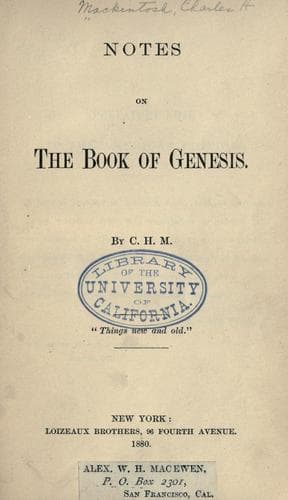
Notes on the Book of GenesisMackintosh, Charles Henry
Religion
Notes on the Book of Genesis
Mackintosh, Charles Henry
Bible. Genesis -- Commentaries
From ver. 9-15, God renews his promise to Jacob, and confirms the new
name of "prince," instead of "supplanter;" and Jacob again calls the
name of the place "Bethel." At verse 18 we have an interesting example
of the difference between the judgment of faith and the judgment of
nature. The latter looks at things through the hazy mist with which it
is surrounded; the former looks at them in the light of the presence
and counsels of God. "And it came to pass, as her soul was in departing
(for she died), that she called his name Ben-oni: but his father called
him Benjamin." Nature called him "the son of my sorrow;" but faith
called him "the son of the right hand." Thus is it ever. The difference
between the thoughts of nature and those of faith must ever be wide
indeed; and we should earnestly desire that our souls should be
governed only by the latter, and not by the former.
CHAPTER XXXVI.
Furnishes a catalogue of Esau's sons, with their various titles and
localities. We shall not dwell on this, but pass on to one of the most
fruitful and interesting sections in the entire canon of inspiration,
viz.:--
CHAPTERS XXXVII-L,
On which we shall dwell more particularly. There is not in scripture a
more perfect and beautiful type of Christ than Joseph. Whether we view
Christ as the object of the Father's love,--the object of the envy of
"his own",--in his humiliation, sufferings, death, exaltation, and
glory,--in all, we have him strikingly typified by Joseph.
In Chapter xxxvii. we have Joseph's dreams,--the statement of which
draws out the enmity of his brethren. He was the object of his father's
love, and the subject of very high destinies; and, inasmuch as the
hearts of his brethren were not in communion with these things, they
hated him. They had no fellowship in the father's love, and they would
not yield to the thought of Joseph's exaltation. In all this they
represent the Jews in Christ's day. "He came to his own, and his own
received him not." He had "no form nor comeliness in their eyes." They
would neither own him as the Son of God, nor King of Israel. Their eyes
were not open to behold "his glory,--the glory as of the only begotten
of the Father, full of grace and truth." They would not have him; yea,
they hated him.
Now, in Joseph's case, we see that he, in no wise, relaxed his
testimony in consequence of his brethren's refusal of his first dream.
"And Joseph dreamed a dream, and he told it to his brethren," and they
hated him yet the more.... "And he dreamed yet another dream, and he
told it to his brethren." This was simple testimony founded upon divine
revelation; but it was testimony which brought Joseph down to the pit.
Had he kept back his testimony, or taken off aught of its edge and
power, he might have spared himself; but, no: he told them the truth,
and therefore they hated him.
Public-domain text, read in full here on John Shaqi.
Reviews
Reviews
No reviews yet
Be the first to share your thoughts on this work.
Elsewhere in the archive
Join the Discussion
Join the discussion
Sign in to leave a comment or review.
Sign InorCreate an account