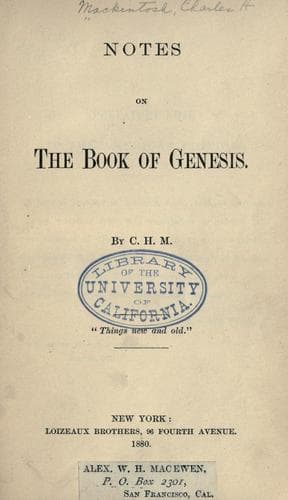
Notes on the Book of GenesisMackintosh, Charles Henry
Religion
Notes on the Book of Genesis
Mackintosh, Charles Henry
Bible. Genesis -- Commentaries
Now, the name of our altar and the character of our worship express the
same idea. El-Bethel worship is higher than El-elohe-Israel worship,
for this simple reason, that it conveys a higher idea of God. It gives
me a more elevated thought of God to speak of him as the God of his
house than as the God of a solitary individual. True, there is
beautiful grace expressed in the title, "God, the God of Israel;" and
the soul must ever feel happy in looking at the character of God, as
graciously connecting himself with every separate stone of his house,
and every separate member of the body. Each stone in the building of
God is a "lively stone," as connected with the "living stone," having
communion with the "living God," by the power of "the Spirit of life."
But while all this is blessedly true, God is the God of his house; and
when we are enabled, by an enlarged spiritual intelligence, to view him
as such, we enjoy a higher character of worship than that which flows
from merely apprehending what he is to ourselves individually.
But there is another thing to be remarked in Jacob's recall to Bethel.
He is told to make an altar "unto God, that appeared unto thee when
thou fleddest from the face of Esau thy brother." He is thus reminded
of "the day of his distress." It is often well to have our minds led in
this way to the point in our history in which we found ourselves
brought down to the lowest step of the ladder. Thus Saul is brought
back to the time when he was "little in his own eyes." This is the true
starting-point with all of us. "When thou wast little in thine own
eyes," is a point of which we often need to be reminded. It is then
that the heart really leans on God. Afterwards we begin to fancy
ourselves to be something, and the Lord is obliged to teach us afresh
our own nothingness. When first one enters upon a path of service or
testimony, what a sense there is of personal weakness and incapacity!
and, as a consequence, what leaning upon God! what earnest, fervent
appeals to him for help and strength! Afterwards we begin to think
that, from being so long at the work, we can get on by ourselves,--at
least there is not the same sense of weakness or the same simple
dependence upon God; and then our ministry becomes a poor, meagre,
flippant, wordy thing, without unction or power,--a thing flowing, not
from the exhaustless tide of the Spirit, but from our own wretched
minds.
Public-domain text, read in full here on John Shaqi.
Reviews
Reviews
No reviews yet
Be the first to share your thoughts on this work.
Elsewhere in the archive
Join the Discussion
Join the discussion
Sign in to leave a comment or review.
Sign InorCreate an account