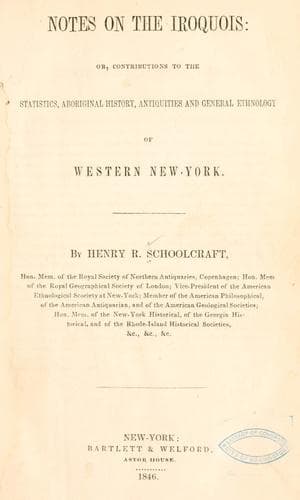
Notes on the Iroquois: or, Contributions to the Statistics, Aboriginal History, Antiquities and General Ethnology of Western New-YorkSchoolcraft, Henry Rowe
History
Notes on the Iroquois: or, Contributions to the Statistics, Aboriginal History, Antiquities and General Ethnology of Western New-York
Schoolcraft, Henry Rowe
Indians of North America -- New York (State); Iroquois Indians
The following specimen of Iroquois picture writing should
have been placed under the article “Onondagas,” where the
omission is supplied, by a head from an ancient pipe, hereafter
described under the class of relics named Opoaguna. It
represents the first Iroquois ruler, under their confederacy,
named Atotarho.
[Illustration]
VI. RELICS OF ABORIGINAL ART IN WESTERN NEW-YORK.
[Antique insignia, amulets, implements and ornaments.]
It will tend to render the work of antiquarian examination exact, and
facilitate comparison, if names descriptive of the general classes
and species of each object of archæological inquiry be introduced.
No science can advance if the terms and definitions of it be left
vague. The mere inception of this design is here announced; it is not
proposed, at present, to do more than submit a few specimens from
a large number of antiquarian articles, the result of many years’
accumulation. The figures and descriptions introduced are confined
exclusively to the geographical area under examination.
To establish the classes of articles, names are introduced from the
Indian vocabulary. These are qualified by specific terms, adjective or
substantive, from the same class of languages, or from the English;
rarely from other sources. A nomenclature derived from such sources,
appeared preferable for these simple objects of savage art, to one
taken from the ancient languages, whose prerogative it has so long been
to furnish terms for science and art.
[Illustration: AMERICAN ANTIQUITIES—Plate I.]
CLASS FIRST. NABIKOAGUNA.[70]
[70] From the Algic, denoting a medal, a breast-plate or collar.
Objects of this kind were worn as marks of honor or rank. So far as
known, they were constructed from the most solid and massy parts of the
larger sea shells. Few instances of their having been made from other
materials, are known, in our latitudes. The ruins and tombs of Central
and South America have not been explored, so far as is known, with this
view. Nor have any insignia of this character been found of stone.
Public-domain text, read in full here on John Shaqi.
Reviews
Reviews
No reviews yet
Be the first to share your thoughts on this work.
Elsewhere in the archive
Join the Discussion
Join the discussion
Sign in to leave a comment or review.
Sign InorCreate an account